What it is
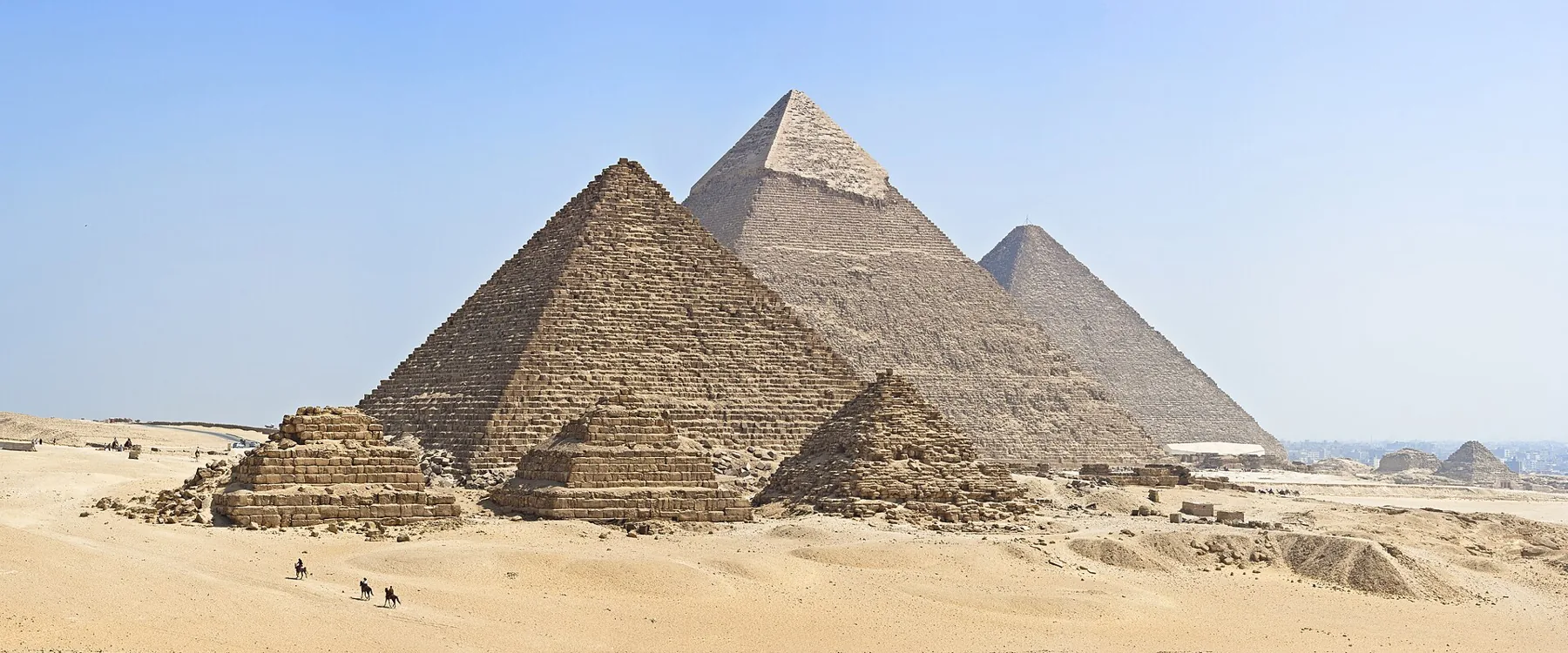
A limestone plateau on the desert edge west of Cairo, where three kings of the Fourth Dynasty, Khufu, his son Khafre and Menkaure, built their pyramids over three generations. The Ministry of Tourism and Antiquities notes that the site was already one of the world's great tourist sights in Roman times, and that Khufu's pyramid remained the tallest building on earth for some 3,800 years.
Each pyramid is only the largest part of a complex: queens' pyramids, a satellite pyramid, tombs of officials and family, boat pits, and two temples joined by a causeway, one near the river and one against the pyramid. The question the plateau as a whole can answer is the one the individual monuments hide: who built all this, and how did they live?
History
The plateau itself made the pyramids possible. Mark Lehner describes it as a plate of limestone, the Mokattam Formation, whose regular surface was ideal for building, with alternating hard and soft layers down the slope that the builders cut away to extract blocks. The south-east corners of the three pyramids lie nearly on a single diagonal that follows the lie of the rock, keeping their bases at similar levels, and Khufu's pyramid is aligned to true north with an error of less than five minutes of arc.
Lehner's own excavations have focused on the people behind the stones. The Great Pyramid contains about 2,300,000 blocks and was built in 23 years or less; Rainer Stadelmann's arithmetic gives about 340 blocks a day, one every two minutes of daylight. Herodotus, writing some two thousand years later, claimed 100,000 men. Lehner suggests that may have been an annual total of rotating teams, and gives 20,000 to 30,000 as the generally accepted figure for the workforce at any one time. They were organised in gangs of about a thousand, with names compounded with the king's: "Friends of Khufu", "Drunkards of Menkaure".
Where did they eat? In 1991 a mechanical digger cutting sand for a building project at the south-eastern edge of the plateau gouged into two Old Kingdom bakeries, full of ash and broken bread moulds. Lehner's team rebuilt one and baked bread in the ancient way, with emmer, barley and wild yeast: each loaf was so dense it could have fed one person for days. Beside the bakeries they found long troughs and benches covered with the fins and bones of catfish, laid out, it seems, to dry and smoke the catch after the flood. "We had, literally, found loaves and fishes". Barry Kemp reminds visitors that the pyramids are only part of a gigantic site of houses, storerooms, workshops and tombs, mostly of this one period.
What you actually see
The three pyramids, the Great Sphinx and Khafre's valley temple, the boat pits and queens' pyramids beside Khufu's, and the fields of officials' tombs around them. The pyramids and the Sphinx each have their own page. Our suggestion is to spend part of the visit looking south-east, towards the low desert where the workers' town and bakeries were found: the pyramids make most sense when you remember the town that fed them.
Practical
The Ministry listing read on 19 September 2026 gives opening hours of 08:00 to 16:00. The area ticket does not cover entry into the Great Pyramid, the pyramids of Khafre and Menkaure, the tomb of Meresankh III or the Workers' Cemetery, each ticketed separately. Recheck before visiting.
