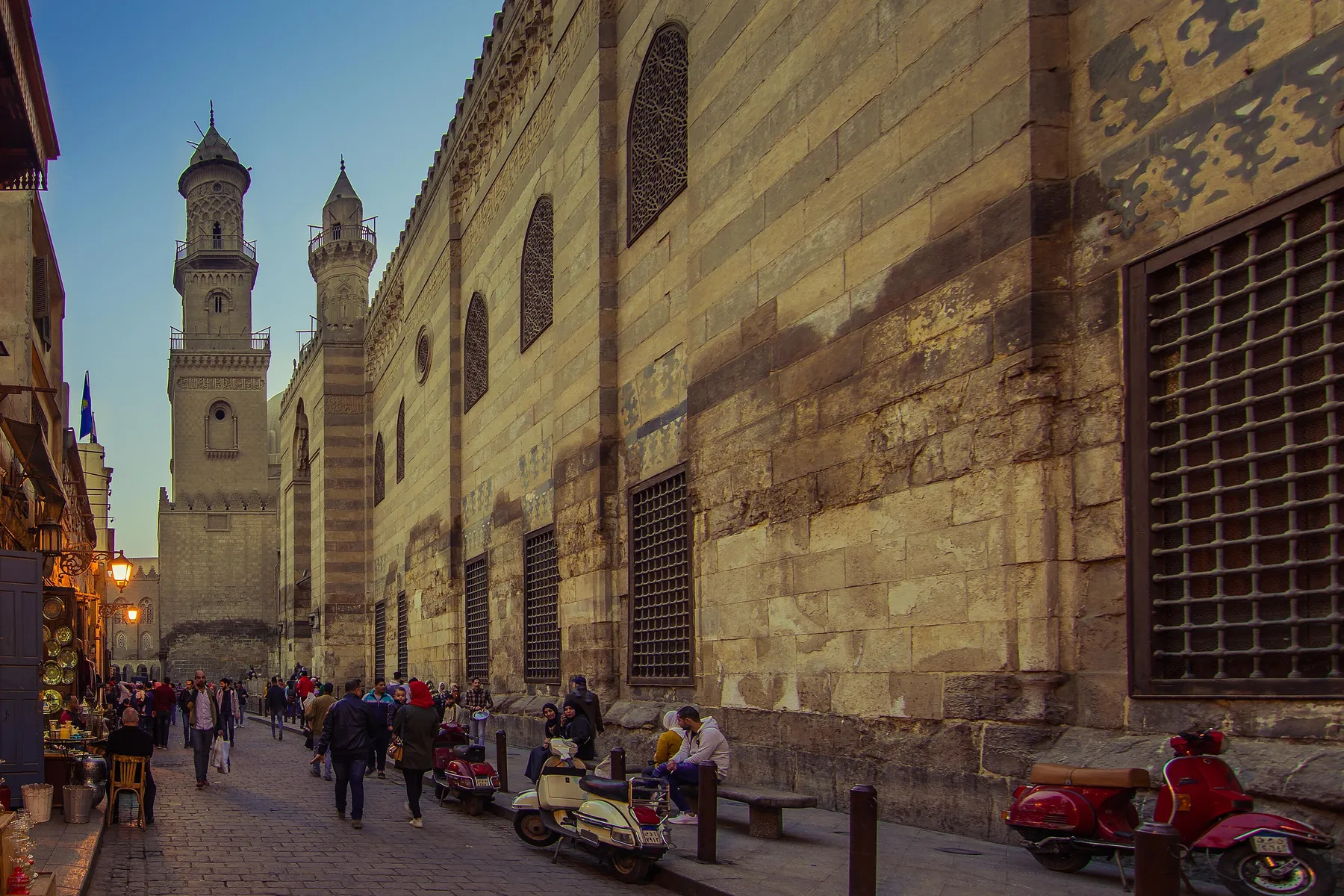
What it is
The main street of historic Cairo. It is named after the Fatimid caliph al-Mu'izz li-Din Allah, who first laid it out in the tenth century, and it runs between two of the old city gates, Bab al-Futuh in the north and Bab Zuwayla in the south. Those two gates mark the northern and southern limits of the Fatimid city proper.
The Ministry counts twenty-nine monuments along it, from the tenth to the nineteenth century, and calls it the largest open-air museum of Islamic monuments in the world. It is part of Historic Cairo, inscribed on the UNESCO World Heritage List in 1979.
The question to carry along it: why did everyone with power in medieval Cairo want to build on this one street?
History
The Fatimids, a Shiite dynasty from Tunisia, took Egypt in 969. Straight away they laid out a new walled city north of the old capital, al-Fustat, to hold the caliph's palace, his offices, his household and his guard. Tradition says it was named al-Qahira because Mars, al-Qahir, "the conqueror", was in the ascendant when the foundations were begun. It became the Fatimid capital in 973, and its name is the one the whole city still carries: Cairo.
This street was its spine, the Qasaba, the central avenue of Fatimid and medieval Cairo. Its heart was Bayn al-Qasrayn, "between the two palaces": a ceremonial ground between the great Eastern Palace and the lesser Western Palace of the caliphs. Nothing of the palaces stands; only carved woodwork from them survives, in the Museum of Islamic Art.
That is the answer to the question. The palaces went, but the prestige of the place stayed. Long after the Fatimids fell in 1171, the street remained a favourite building site for anyone who held power, and the name Bayn al-Qasrayn lived on when two amirs of Sultan al-Nasir Muhammad, Baysari and Bashtak, built their own palaces here. Naguib Mahfouz set the first volume of his Cairo Trilogy, Bayn al-Qasrayn, in English Palace Walk, in these streets.
The most ambitious of those builders was Sultan Qalawun. Born in the Kipchak lands of the lower Volga, he came to Egypt as a mamluk, a slave soldier, of the sultan al-Salih Ayyub, became sultan himself in 1279 and died in 1290 on his way to attack the Crusader fortress of Acre. His hospital, madrasa and mausoleum, built in 1284–85, are the earliest monumental examples in Egypt of the styles and techniques brought from Syria. The hospital was the wonder of the age: four great halls, one each for fevers, eye diseases, surgery and dysentery, a separate hall for women, open to all, with musicians and storytellers to entertain the patients.
At either end, the street is closed by the Fatimids' second walls. In 1087 the Armenian vizier Badr al-Gamali replaced the first, sun-dried brick wall of Gawhar in stone. His masons came from northern Mesopotamia, and Bab al-Futuh, Bab al-Nasr and the wall between them are rare examples of military architecture built before the Crusades. Bab Zuwayla, at the southern end, followed in 1092. It is named after Berber soldiers of the Zawila tribe who were quartered beside the first gate of 969, and its two minarets were added in the fifteenth century.
What you actually see
Walk it as a sequence of rulers, each answering the last.
In Bayn al-Qasrayn, Qalawun's complex still dominates the street. Williams compares the sanctuary of his madrasa to a northern Syrian basilica, with a mihrab hood in glass mosaic, and his tomb chamber, an octagon set in a square on granite columns, to the Dome of the Rock in Jerusalem.
Further north, the small Mosque of al-Aqmar, "the moonlit", built in 1125, once stood at the corner of the Eastern Palace. Its facade carries a programme that is explicitly Shiite and rare in Islamic buildings: around a niche, the roundels of Muhammad and 'Ali are placed so that the inscription can also be read as "God is with Muhammad and 'Ali". The street has risen so far since it was built that you now step down to the door. Williams counts it among the few Fatimid buildings to have survived the centuries more or less intact, and regrets that a sweeping restoration in 1993 gave it new inscriptions, windows and marble.
At the northern end, look closely at Bab al-Futuh itself. Blocks carried from the pharaonic city of Memphis were built into it, and some still carry their reliefs: a hippopotamus under a window, a procession of offering bearers. From the top of the gate, Williams writes, the Fatimid street runs south, lined with shops, all the way to Bab Zuwayla in the distance. Whether the wall walk is open on the day should be checked locally.
Practical
The Ministry listing read on 29 September 2026 gives opening hours of 09:00 to 17:00 every day, and a ticket for foreign adults of EGP 220 (students EGP 110). The inclusive ticket covers the Qalawun group, the madrasas of al-Nasir Muhammad, Barquq and al-Kamil, the mosque and sabil of Sulayman Agha al-Silahdar, the Ben Maimon synagogue, the Hammam of Inal and the palace of Bashtak. It does not cover Bayt al-Suhaymi or Wikalat Bazaraa. Recheck before visiting.
In our judgement, go in the morning if you want the interiors: they close at 17:00.
