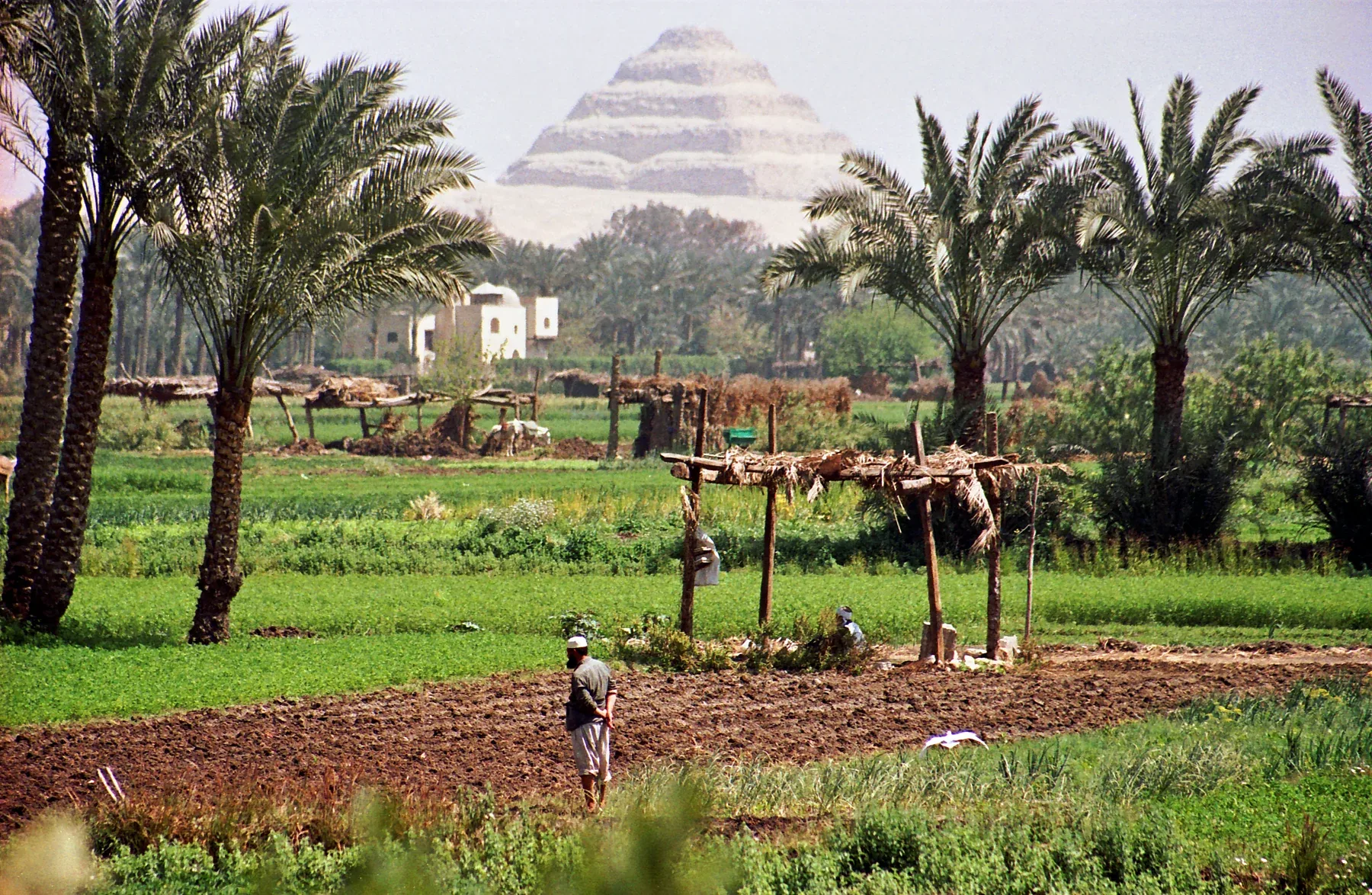
What it is
The funerary complex of the king the Egyptians of his own time called by his Horus name, Netjerykhet, and whom later generations knew as Djoser. It stands in the necropolis of Saqqara. At its centre is the Step Pyramid, six stacked mastabas that rise in steps, inside a vast walled enclosure of courts, chapels and buildings, most of them solid imitations.
It is usually described as a beginning. Barry Kemp calls it the first building of truly monumental scale in Egypt constructed throughout of stone; the Oxford History calls it the first monument in the world made entirely of stone on a truly huge scale.
History
The king's dates depend on the chronology used. The official listing places his reign in the early Third Dynasty, c. 2667–2648 BC. Mark Lehner gives a nineteen-year reign, 2630–2611 BC; Toby Wilkinson gives 2650–2620; Kemp dates him c. 2584–2565 BC. Lehner notes that "Djoser" is the name New Kingdom visitors gave the king more than a thousand years later. The only royal name found on the walls of the complex is Netjerykhet.
The architect is traditionally Imhotep, and the evidence for that is worth knowing. A statue base from the entrance colonnade carries his name beside the king's, with titles that include royal seal bearer and "greatest of seers". But, as Toby Wilkinson points out, he is nowhere explicitly named as the architect; he is simply the only plausible candidate. Imhotep's fame grew long after him. Emily Teeter notes that his cult is attested only from the beginning of the New Kingdom, about a thousand years after his death.
The pyramid was not planned as a pyramid. Lehner describes it growing in stages, following its excavator Jean-Philippe Lauer: first a square mastaba, then enlargements, then a four-step and finally a six-step pyramid, about 60 m high. Around it ran a limestone enclosure wall 10.5 m high and 1,645 m long, enclosing some 15 hectares. Its face was worked into bastions and 1,680 recessed panels.
Much of what stood inside was never meant to be used. Corinna Rossi describes a building in stone that still refers to architecture in lighter materials. The small, equal blocks of the pyramid recall mud brick, and many secondary buildings are "petrified" versions of chapels and pavilions. The official listing reads the two courts in front of the pyramid as recreating the setting of the Sed festival, a royal ceremony of renewal, and the South Tomb as a second, symbolic tomb for the king. Kemp adds a caution. Very little of the complex carries figures or texts that declare its meaning, so much of that meaning has to be read back from later sources, and there is no straightforward answer to why a stepped pyramid.
Below ground the builders went further still. Lehner describes more than 5.7 km of shafts, tunnels, chambers, galleries and magazines. A central shaft 7 m square and 28 m deep leads to a granite burial vault, closed with a granite plug of about 3.5 tonnes. Chambers beneath both the pyramid and the South Tomb were lined with blue faience tiles framed by limestone, imitating a structure of reed matting. Three false-door stelae beneath each show the king performing a ritual run. In galleries beneath the pyramid excavators found around 40,000 stone vessels. Many bore inscriptions showing they were not made for Djoser but probably for his royal ancestors.
What you actually see
On the north side of the pyramid stands the serdab, a closed chamber with two holes cut in its face. Djoser's statue inside looked out through them, towards the stars of the northern sky that never set, in Rossi's account. Lehner records that the statue now in the serdab is a replica and the original is in the Cairo Museum.
Around the complex, look at the enclosure wall with its recessed panels, the colonnaded entrance, and the court and chapels associated with the Sed festival. Lehner notes that many passages and entrances are barely wider than a metre, and that traces of paint show many limestone façades and pillars were painted red to imitate wood.
Practical
- Open 08:00-17:00 daily, per the Ministry listing read on 2026-09-14.
- Which parts of the complex and its substructure are open changes; check the listing before you go.
