What it is
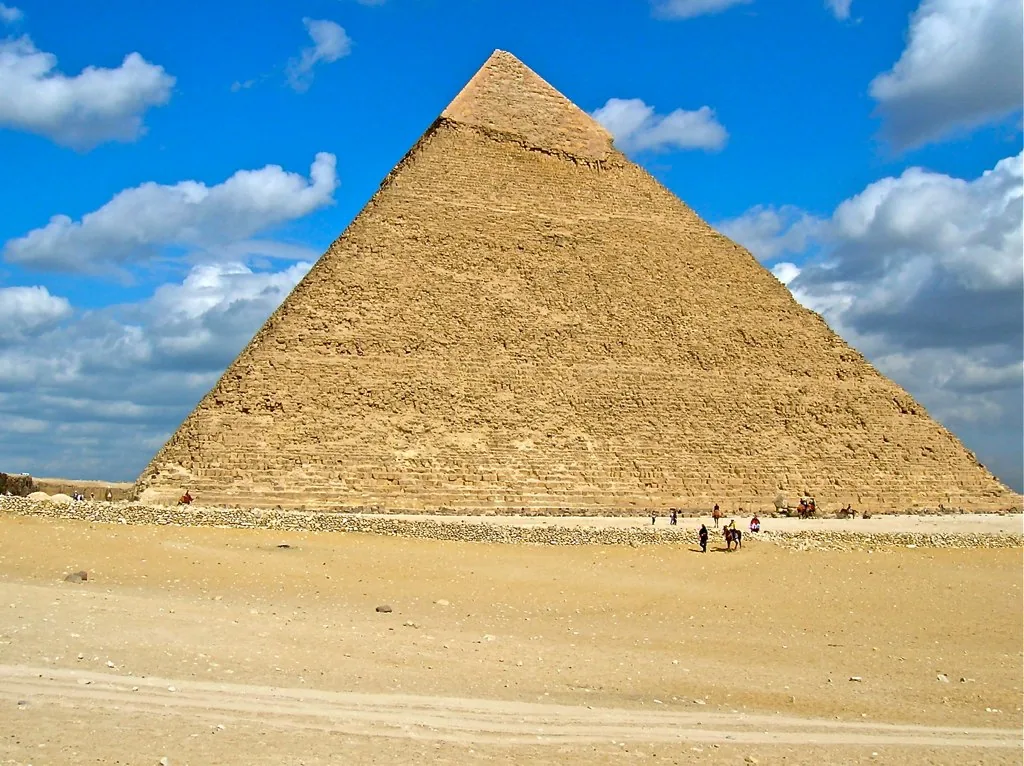
The pyramid that looks tallest at Giza and isn't. Khafre, a son of Khufu, built his pyramid beside his father's and set it on bedrock about 10 m higher, with a slightly steeper slope, so that it seems to stand shoulder to shoulder with the Great Pyramid while being the smaller of the two. It is the one with a cap: near its top, a band of the fine white limestone casing that once covered the whole pyramid still survives.
Mark Lehner describes Khafre's complex as the best preserved of the three at Giza, and the most complete way to see what a pyramid actually was: not a lone monument but a machine of temples, a causeway and statues, ending in the Great Sphinx. The question it answers is what the pyramid was for.
History
The Ministry of Tourism and Antiquities gives the pyramid's height as 143.5 m and notes that the casing was fine limestone quarried at Tura, south of Cairo, and brought by ship. Lehner describes how the builders cut the rock down by about 10 m at one corner and built up with huge blocks at the other to make a level terrace, and how the four corners were not quite aligned to meet at the top, leaving a very slight twist. Even now, he concludes, with Khafre's the fifth of the giant pyramids, "pyramid-building techniques were still largely ad hoc".
The mortuary temple against the pyramid's east face was larger than any before, and the first to include all five elements that later became standard: an entrance hall, a columned court, five niches for statues of the king, five storerooms and an inner sanctuary. Statues were at the heart of it. Khafre's reign saw an explosion of statue-making unmatched until the New Kingdom; more than 52 statues of life size or larger stood in the complex. Almost none remain, Lehner explains, because they were removed intact by royal order, possibly in the Eighteenth Dynasty or by Ramesses II, and reused.
Inside the pyramid, the burial chamber still holds Khafre's black granite sarcophagus, half sunk into the floor. Giovanni Belzoni reached it in 1818, and found he was not the first: someone had been in before him. The bones found in the sarcophagus turned out to be a bull's, probably, Rainer Stadelmann suggests, an offering thrown in by later intruders long after the king's body was lost.
What you actually see
Start at the bottom. The valley temple, near the Sphinx, is built of huge limestone blocks sheathed in red granite, with an alabaster floor and monolithic granite pillars. Twenty-three statues of the king once stood around its T-shaped hall, lit only by narrow slits high in the walls. One of them, the seated Khafre with the falcon Horus folding its wings around his head, was found here by Auguste Mariette; it is now in the Egyptian Museum in Cairo and widely considered one of the masterpieces of Egyptian art.
Then follow the line of the causeway up to the pyramid and look at the top: the surviving casing, and below it the rough stepped core. In our judgement this is the best place at Giza to understand a pyramid as a sequence of spaces rather than a single shape.
Practical
The Ministry page for this complex gives no separate hours. The Giza Plateau listing read on 19 September 2026 gives 08:00 to 16:00; entry inside the pyramid needs its own ticket in addition to the plateau ticket. Recheck before visiting.
.jpg)