What it is
The place where the Egyptians learned how to build a pyramid, by getting it wrong first. Two of the largest pyramids in Egypt stand here, both built by the same king, Sneferu, in the same reign: one that bends halfway up, and one that does not. Between them they record a lesson that the Great Pyramid at Giza, built by his son, took for granted.
Dahshur is quieter than Giza, and in our judgement it is the better place to understand what a pyramid actually is: an engineering problem that nearly defeated the people who solved it.
History
In about the fifteenth year of his reign, Sneferu, first king of the Fourth Dynasty, abandoned his pyramid at Meidum and moved some 40 km north to found a new royal cemetery at Dahshur. Mark Lehner notes one suggested motive: to be nearer the apex of the Delta and the growing trade with the Levant.
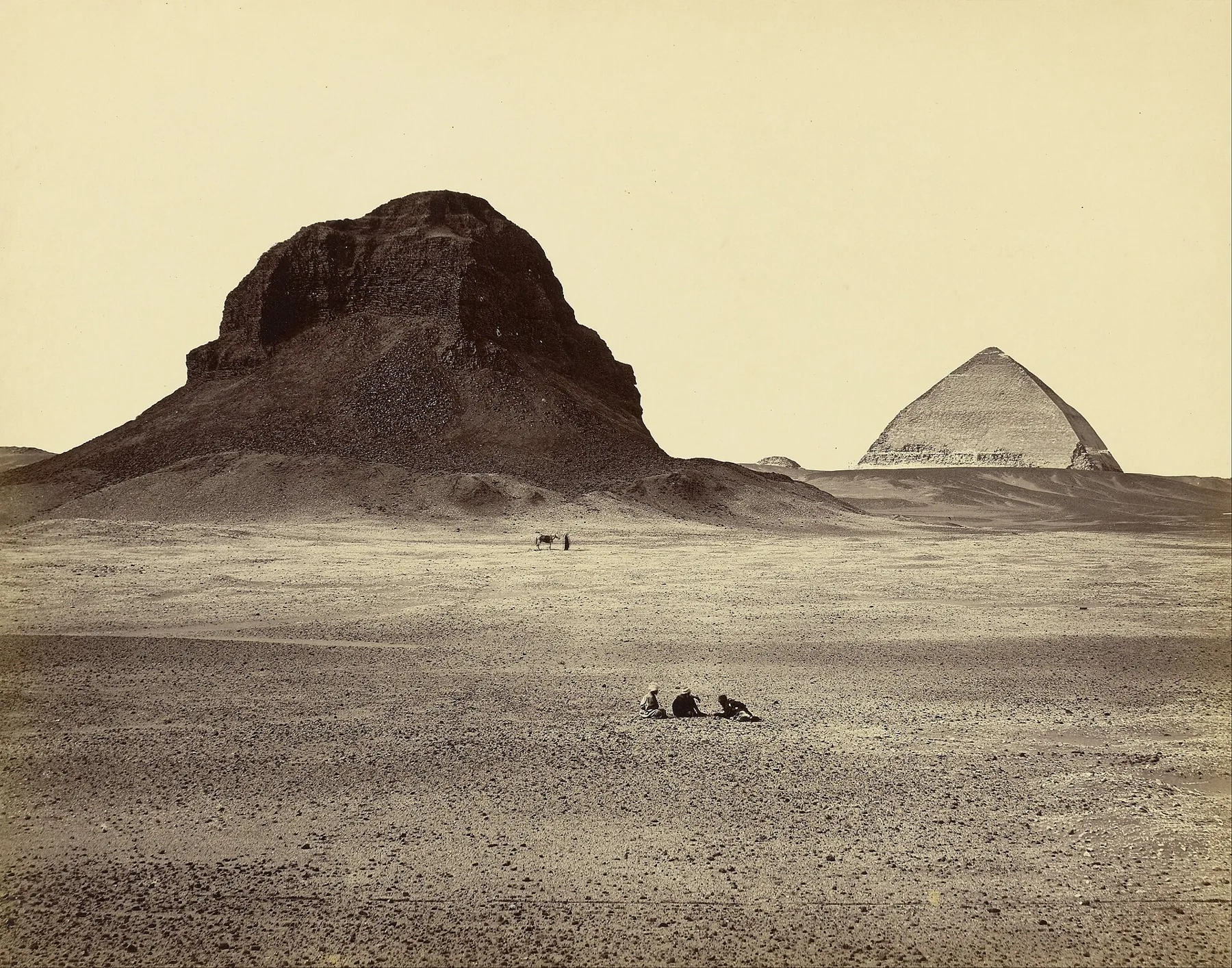
His first pyramid here began to fail as it rose. Built on unstable desert sand, gravel and clay, it subsided and cracked, and its builders changed the angle part of the way up, giving the Bent Pyramid its shape. Around his thirtieth year Sneferu began a second pyramid a little to the north, planned from the start at the gentler angle, and it became the Red Pyramid, probably his tomb. Toby Wilkinson estimates that in this third decade of the reign, with three pyramids under way at once (the king's builders also returned to finish Meidum), between 130,000 and 200,000 cubic yards of stone were laid each year, a rate probably never surpassed, even at Giza.
The Bent Pyramid's valley temple carried a frieze of women bringing offerings, each one personifying a royal estate. Toby Wilkinson reads it as Sneferu announcing that his pyramid was a national enterprise, involving the whole country, "whether the populace liked it or not". That temple then became the centre of a cult that lasted far longer than the king. Unlike the Giza builders, who seem to have been ignored in the Middle Kingdom, Sneferu was still worshipped here centuries later, and his name stayed popular throughout pharaonic history.
Middle Kingdom kings came back to Dahshur, beginning with Amenemhat II. Amenemhat III built his mudbrick pyramid on the same kind of ground as Sneferu and ran into the same subsidence and cracking, which probably explains why he built another pyramid at Hawara, just as Sneferu had built a substitute to the north. The Ministry of Tourism and Antiquities notes that the capstone of Amenemhat III's "Black Pyramid" is on display in the Egyptian Museum.
What you actually see
Two stone mountains in open desert, about a kilometre apart, and on the edge of the cultivation the eroded mudbrick pyramids of the Middle Kingdom. Stand where you can see both of Sneferu's pyramids at once and compare their profiles: the bend on one, the single low slope on the other. That comparison is the whole story of the site, and it is what the Bent Pyramid and Red Pyramid pages explain.
Practical
The Ministry listing read on 19 September 2026 gives opening hours of 08:00 to 17:00. Recheck before visiting. Dahshur is usually combined with Saqqara and Memphis on the same day.