What it is
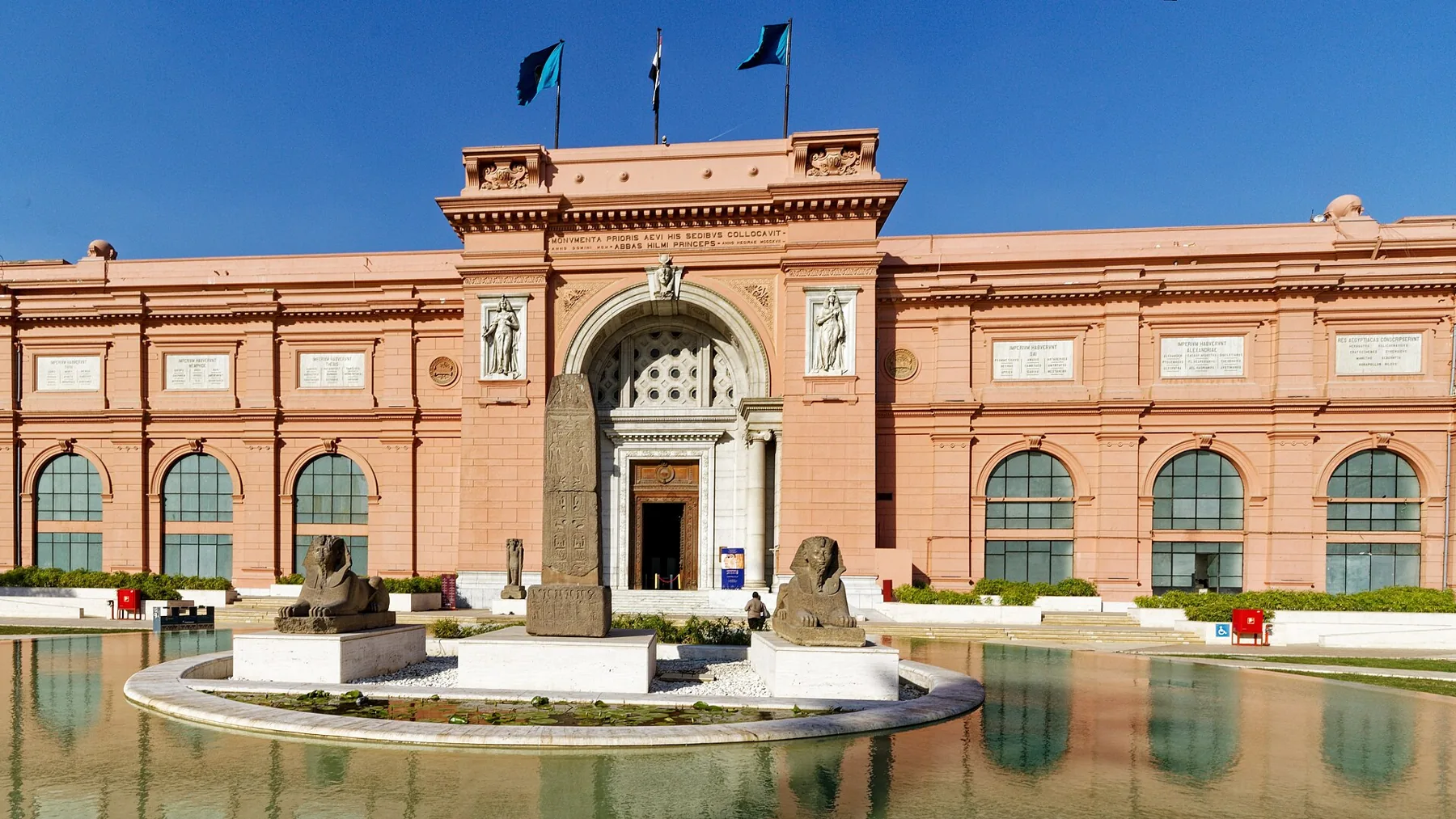
The old museum on Tahrir Square, opened in 1902 and crowded with more pharaonic antiquities than any other collection in the world, according to the Ministry of Tourism and Antiquities, which also calls it the oldest archaeological museum in the Middle East. Tutankhamun's burial goods now have their own galleries at the Grand Egyptian Museum. What stays here is the long view: Egypt from the Predynastic Period to the Graeco-Roman era, in one building.
In our judgement it is where a first-time visitor should meet the beginning and the end of the story before seeing the monuments in between. The question it answers is how Egypt began to look like Egypt.
History
The museum grew out of Auguste Mariette's work. After he was put in charge of the new Antiquities Service in 1858, he founded a museum at Boulaq to gather the country's finds; the collection later moved to Giza and finally to Qasr el-Nil, today's Tahrir. The present building was chosen by international competition in 1895, the first of its kind, won by the French architect Marcel Dourgnon, and was inaugurated in 1902 by the Khedive Abbas Helmy II.
What you actually see
Start with the Narmer Palette, which Toby Wilkinson describes in its place of honour at the entrance. He calls this modest slab of siltstone the object that marks the very beginning of Egyptian history. Found in 1897–98 by James Quibell and Frederick Green at Nekhen, the ancient Hierakonpolis, it names its king with two signs, a catfish and a chisel, nar and mer: Narmer, whom Wilkinson places at the start of the First Dynasty, around 2950 BC. Barry Kemp sees in it the full artistic canon of pharaonic Egypt already in place: the king in the crowns of Upper and Lower Egypt, facing the god Horus. Not everyone reads it as a record of unification. Kathryn Bard calls that interpretation too specific, and reads its scenes of dead enemies and conquered places as evidence that warfare played some part in forming the early state.
Then look for the builders of Giza. The Ministry lists statues of Khufu, Khafre and Menkaure among the collection. Khufu is the surprise. Toby Wilkinson calls it one of the greatest ironies of archaeology that the only certain image of the man who built the Great Pyramid is an ivory statuette about three inches high, found at Abydos. Campbell Price adds a caution: it is the only labelled sculpture of the king, and it may be significantly later in date.
The Ministry also points to the complete burials of Yuya and Thuya, and the treasures of the Twenty-first Dynasty king Psusennes I from Tanis.
Practical
The Ministry listing read on 19 September 2026 gives opening hours of 09:00 to 17:00, with an optional audio tour. Recheck before visiting.
