What it is
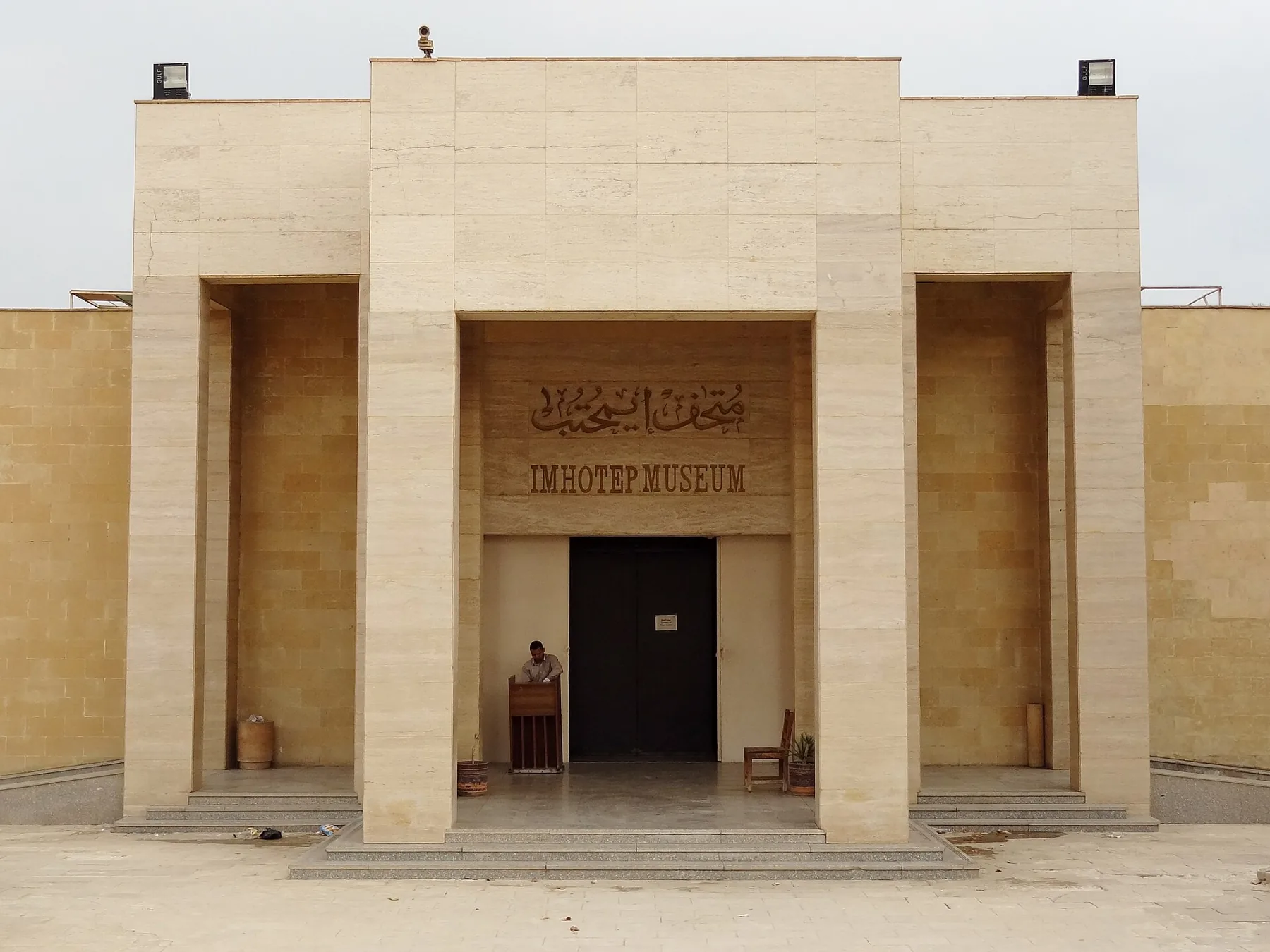
The museum at the gate of Saqqara, named after the first person in history to whom a great building can be credited. The Ministry of Tourism and Antiquities describes six halls of statues, coffins, paintings, tools, architectural elements and other finds from Saqqara, a reconstructed tomb with a mummy, a wooden coffin and funerary furniture, and a hall in memory of Jean-Philippe Lauer. Lauer came to Saqqara in 1926 as a young architect, to work on the Step Pyramid for eight months, and spent the next seventy years rebuilding the complex around it from the broken pieces he found in the debris.
It is the right place to start a Saqqara day. The question it raises is how a court official became a god.
History
Imhotep served King Djoser, builder of the Step Pyramid, about 4,700 years ago. His name survives on the base of a statue of Djoser found at the Step Pyramid, with his titles: seal-bearer of the king of Lower Egypt, first under the king, administrator of the great estate, chief of seers. Toby Wilkinson points out that none of these titles actually calls him the architect; but nobody else at the court held such a position, nobody else was commemorated inside the complex, and he is the only plausible candidate. His name appears again on the wall of the unfinished pyramid of Djoser's successor, Sekhemkhet.
His fame grew for thousands of years. Barry Kemp notes that 1,500 years later, in the New Kingdom, he was honoured not as a builder but as a sage, the author of sayings people still quoted: one song says, "I have heard the words of Imhotep and Hordedef". By the Twenty-sixth Dynasty he had become a god, a son of Ptah of Memphis, with healing as his speciality, and the Greeks identified him with their healing god Asklepios.
Toby Wilkinson tells how, in the last century of Ptolemaic rule, a high priest's wife named Taimhotep, desperate for a son after three daughters, prayed to Imhotep, "worshipped throughout Egypt as a god of wisdom, magic, and medicine" and especially strong in Memphis. His tomb, probably at Saqqara, has never been found. Jaromír Málek calls it one of the most exciting prospects for future fieldwork.
What you actually see
Start with the architectural elements, then the reconstructed tomb, then the Lauer hall. Our suggestion is to come here first and then walk up to the Step Pyramid, so that you arrive knowing whose idea it was.
Practical
The Ministry listing read on 19 September 2026 gives opening hours of 08:00 to 17:00, with the ticket window closing earlier. Entry is included in the Saqqara area ticket. Photography with a mobile phone is free; flash and tripods are not permitted. Recheck before visiting.
_02.jpg)