What it is
The temple the god came to visit. Every year Amun of Karnak travelled south along the river and the avenue of sphinxes to Luxor, to meet a form of himself that lived here, Amun of the Opet, and to renew the power of the king. Richard Wilkinson calls it the "Southern Opet", the "Place of Seclusion".
It has been a sacred place, in one form or another, for more than three thousand years. The question it answers is how one building held all of that belief.
History
Hatshepsut built here, but the core of the temple you see was built by Amenhotep III, the Eighteenth Dynasty's "sun king", in stages: first the inner rooms on a raised platform, then the great sun court, then the foundations of the colonnade to the north. His son Akhenaten turned against the cult of Amun, and the colonnade was left unfinished until Tutankhamun restored Amun's worship and decorated it. Ramesses II then added a great court and pylon on a new axis that swung east to line the temple up with Karnak, and built the triple shrine for the visiting boats of Amun, Mut and Khonsu.
The reason for all of it was the Opet Festival. John Coleman Darnell traces its first attestation to Hatshepsut's reign. Under Thutmose III it lasted eleven days; by the reign of Ramesses III it ran for twenty-four. Its rituals celebrated the sacred marriage of Amun, with whom the king merged, and the goddess Mut, so that the royal ka, the king's divine life-force, passed on and kingship was renewed. Wilkinson notes that the "birth room" of Amenhotep III, showing the king's divine conception, may reflect a sacred marriage performed during the festival.
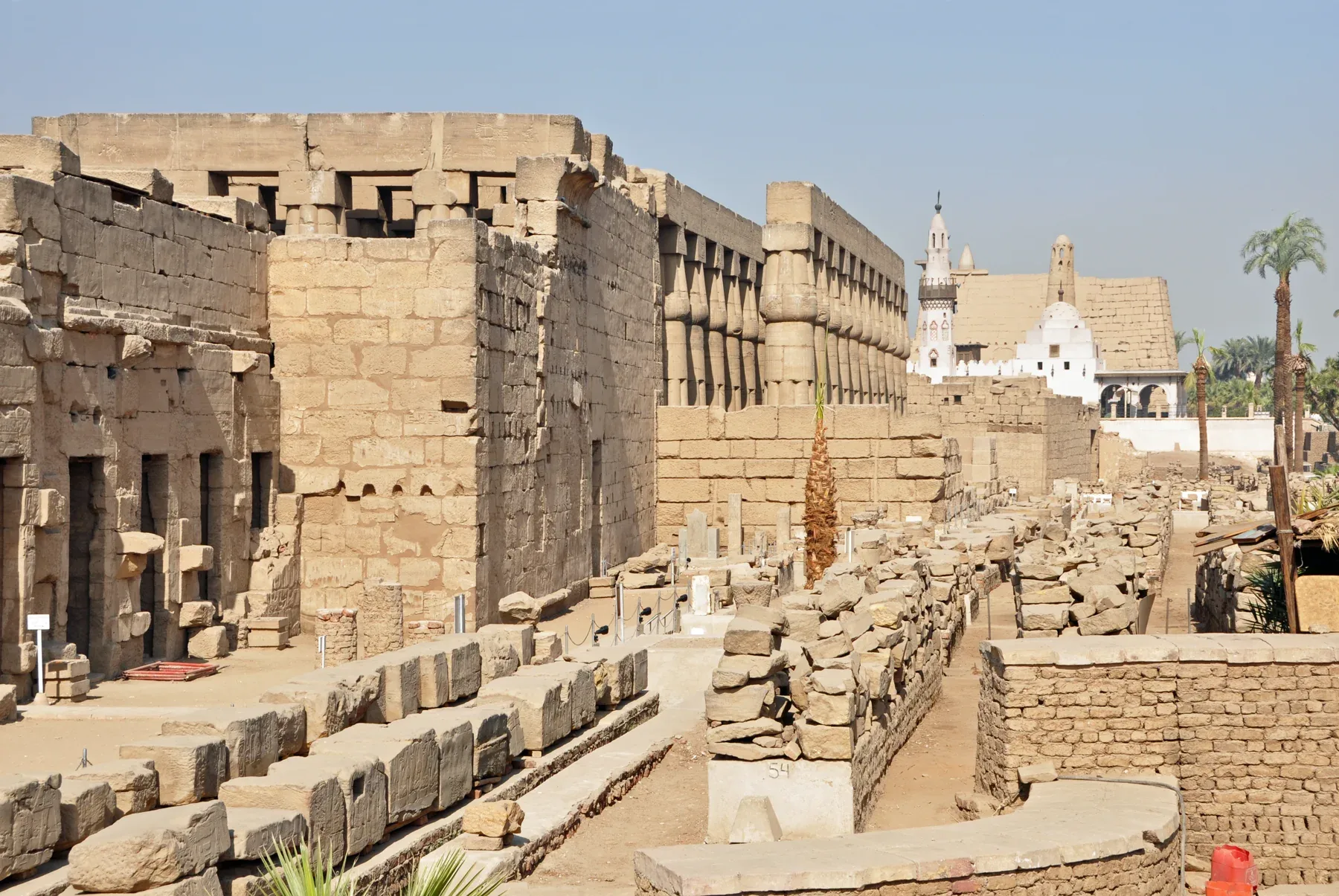
The temple never stopped being used. Alexander the Great had the central barque shrine rebuilt in his own name. Roman soldiers turned the temple into a fortified camp and converted a hall into a chapel of the emperor. Churches were built in and around it, and in the thirteenth century the Mosque of Abu el-Haggag was built over one of them, inside Ramesses II's court, where it is still in use. Darnell adds that echoes of the Opet Festival itself may have survived in later Coptic and Islamic celebrations.
What you actually see
Enter through Ramesses II's pylon, once fronted by six colossal statues and two obelisks. One obelisk and two statues went to Paris in the nineteenth century. The obelisk still here has a twin in the Place de la Concorde; see the Muhammad Ali Mosque page for how it got there.
Inside the court, the Mosque of Abu el-Haggag stands on the left. Then walk the colonnade of Amenhotep III, its great columns each over 19 m tall. Tutankhamun decorated its walls with the Opet Festival itself: the procession from Karnak on the west wall, and, better preserved, the return on the east. In the inner temple, look for Alexander the Great shown as a pharaoh on the walls of the barque shrine, and for the hall that the Roman legion turned into a chapel of the imperial cult.
Practical
The Ministry of Tourism and Antiquities listing, consulted on 15 September 2026, gives opening hours of 06:00 to 20:00. Recheck before visiting. In our judgement the temple is worth seeing twice, once in daylight for the reliefs and once after dark.
