What it is
Not a temple. A temple city. Karnak holds the precinct of Amun at its centre, the precinct of Mut to the south and the precinct of Montu to the north; to the east lay Akhenaten's temple to the Aten. In the Thirtieth Dynasty, Nectanebo I enclosed the temples of Amun-Ra, Mut and Montu within huge mud-brick walls.
Its ancient name was Ipet-sut, which the official Egyptian monuments listing renders "the most select of places". It was also enormously rich. According to the Great Harris Papyrus, by the end of Ramesses III's reign the temples owned a third of Egypt's cultivable land, and three-quarters of that belonged to Amun of Thebes. Jacobus van Dijk describes the priesthood of Amun growing ever more powerful beside the king; by the Late Period, in Alan Lloyd's account, it had become a formidable rival to royal authority.
History
The critical thing to understand before walking in is that Karnak is not one building. The temple of Amun-Ra was built, demolished, renovated and enlarged over more than fifteen hundred years. Its core was the Middle Kingdom temple of Senusret I. New Kingdom kings added pylons and courts around it and in front of it, and later kings repeatedly moved the entrance further west, toward the river.
This is why the site reads as confusing, and why the walk in from the west runs backwards through time. The gateway you enter by, the First Pylon, was begun under Nectanebo I (380–362 BCE) and never finished.
The Great Hypostyle Hall is the set piece: 103 m across and 52 m deep, holding 134 columns. The twelve down the central aisle stand 21 m tall with open papyrus capitals 5.4 m across; the remaining 122 are closed-bud columns of 15 m, sixty-one to a side. The difference in height made room for a band of clerestory windows with stone grilles, reaching the ceiling at 24 m, and light entered the hall through them.
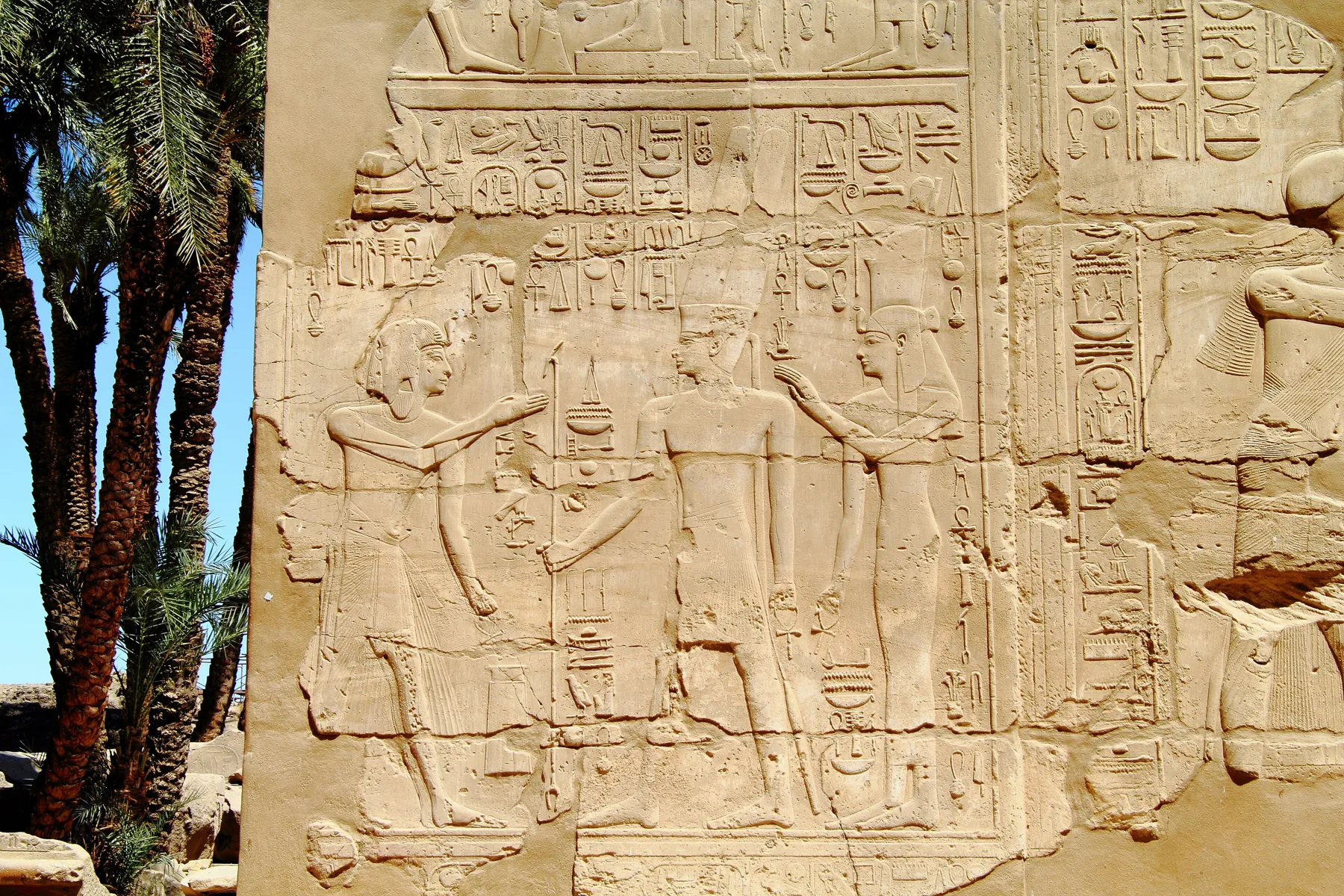
Two kings decorated the hall, and the depth of the carving still tells them apart. Inside the northern half, Seti I's sculptors worked in raised relief: they cut the background away so the figures stand out from the wall. His son Ramesses II's sculptors started the southern half the same way, then changed to sunk relief, cutting each figure down into the stone, and went back over much of the raised carving they had already done. In places the recutting was not complete, and traces of the earlier raised version survive beside the later lines. Sources describe sunk relief as the quicker technique; none we have read gives the king's reason for the change. The great battle scenes on the outer walls are a separate case: they are cut in bold sunk relief. Brand, Feleg and Murnane's OIP 142, free from ISAC Chicago, is the full epigraphic record of the hall's reliefs.
The temple was not a place of congregation. The most sacred rites, performed in temple sanctuaries, excluded ordinary people and even the lower ranks of priests, though other parts of temples were set aside for public prayer and assembly. Festivals gave people a direct part in the cult, and at Opet the gods travelled in procession from Karnak to Luxor Temple.
The sphinx-lined road between the two temples, the Avenue of Sphinxes, runs about 2,700 m. Much of it lay buried beneath later houses and buildings. Excavations from the 1970s onward uncovered it in stages, and it was opened in a ceremony on 25 November 2021.
What you actually see
Enter through the First Pylon into the great forecourt, laid out by Shoshenq I, first king of the Twenty-second Dynasty, with colonnades along its north and south sides. Inside the court, look for the remains of the mud-brick ramps used to build the pylon: direct physical evidence of how these gateways went up.
Then the Hypostyle Hall, which is the reason people come. Look at the depth of the carving. Where the background is cut away and the figures stand out, the relief is raised; where the outline is cut down into the stone and the wall face left standing around it, the relief is sunk.
Beyond it stand the obelisks of Hatshepsut, raised in what is called the wadjet hall. One still stands; the upper section of its fallen southern twin is displayed near the Sacred Lake. A later gateway enclosed their bases in its stone jambs. Digital Karnak attributes that gateway to Thutmose III, who added his own lines of text beside the queen's on the parts left visible, and notes a newer analysis suggesting Hatshepsut may have enclosed them herself.
South of the main axis lies the Sacred Lake, and near it the Open Air Museum. It holds two shrines rebuilt from recovered blocks. Amenhotep III dismantled the White Chapel of Senusret I, a limestone barque shrine, and used it as fill inside his Third Pylon. The Red Chapel of Hatshepsut was taken down under Thutmose III, and Amenhotep III later laid its blocks in the foundations of the same pylon. In our judgement it is worth the time.
Practical
- Open 06:00-17:00 daily, per the Ministry listing read on 2026-09-14.
- The Ministry's ticket for foreign visitors covers Karnak Temple and the Open Air Museum; the Temple of Mut is ticketed separately. Ticket arrangements change, so check the listing before you go.
- Our advice is to arrive at opening, especially in summer.
- Allow at least 2.5 hours; that is our estimate, not an official figure.
