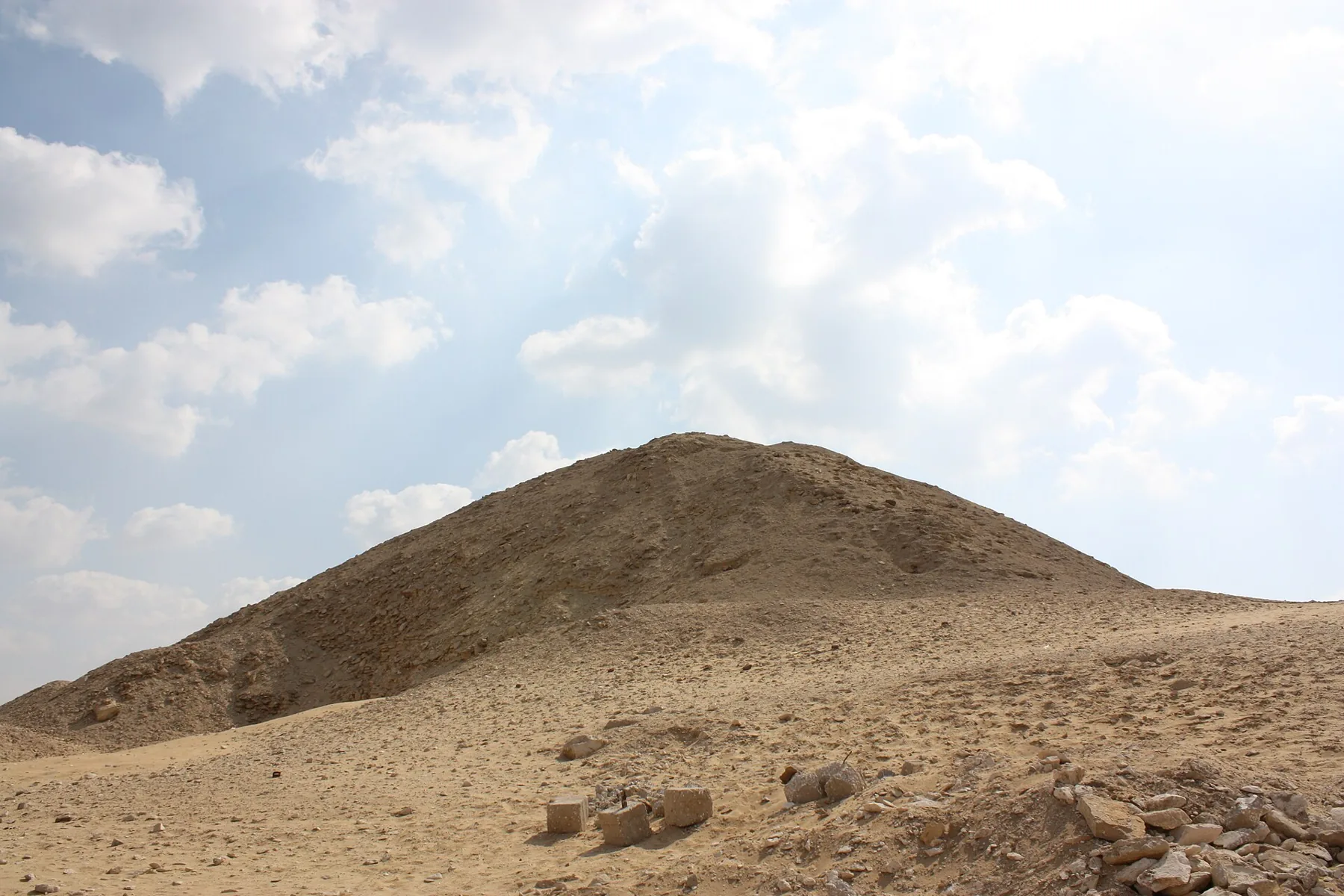
What it is
From outside, a heap of rubble that looks like a hill. Inside, one of the oldest libraries of religious writing in the world. Teti, first king of the Sixth Dynasty, built his pyramid at Saqqara with a core of small local blocks and rubble; when its fine limestone casing was stripped in antiquity, the core slumped. His burial chambers survived intact, their walls covered with the Pyramid Texts, the spells meant to carry the king through death to the dawn.
The question it answers is what a king needed to take with him to eternity, and the answer here is words.
History
Teti was not born to the throne. Toby Wilkinson describes him as a commoner who, when the previous king Unas died without a son, took the throne and swiftly married Unas's daughter, Iput, to secure it. He surrounded himself with loyal ministers, and their tombs press close against his pyramid: the viziers Kagemni and Mereruka were buried in the cemetery at its foot, in some of the grandest private tombs of the Old Kingdom.
The Egyptian historian Manetho, writing some two thousand years later, claimed that Teti was murdered by his bodyguards. The Ministry notes there is little evidence to support this. Miroslav Bárta points to details inside the pyramid that suggest at least a sudden end: its Pyramid Texts were carved but never painted, unlike those in other royal pyramids, and Teti's sarcophagus still rests on the wooden beams used to install it, as if the burial had to be finished in haste. The officials of his court also left tombs whose owners' names were later erased.
His pyramid gave its name to a city. The part of the capital that grew east of it took its name, Djed-isut, from the pyramid and its town, as the later name Mennefer, Greek Memphis, came from the pyramid of his son Pepi I.
The Pyramid Texts in these chambers were first found in 1881, by the brothers Emile and Heinrich Brugsch, in the pyramids of Unas, Teti, Pepi I, Merenre and Pepi II.
What you actually see
Go underground. A sloping passage leads to a corridor, an antechamber and the burial chamber, where the ceiling is painted with gold stars on a dark blue ground, the tomb as a model of the sky. The walls are lined with columns of hieroglyphs. In Teti's corridor they speak of passing through the marshes at the edge of the horizon, the place of transformation where the king becomes an akh, an effective spirit able to rise at dawn.
Then visit the tombs of Teti's officials. Toby Wilkinson singles out Mereruka's, where the scenes of daily life include antelopes feeding at mangers, cranes being force-fed and hyenas being fattened for the table. The Ministry lists the Tomb of Mereruka among the Saqqara tombs with a separate ticket.
Practical
The Ministry listing read on 19 September 2026 gives opening hours of 08:00 to 17:00. Recheck before visiting, and confirm locally whether the interior is open.
