What it is
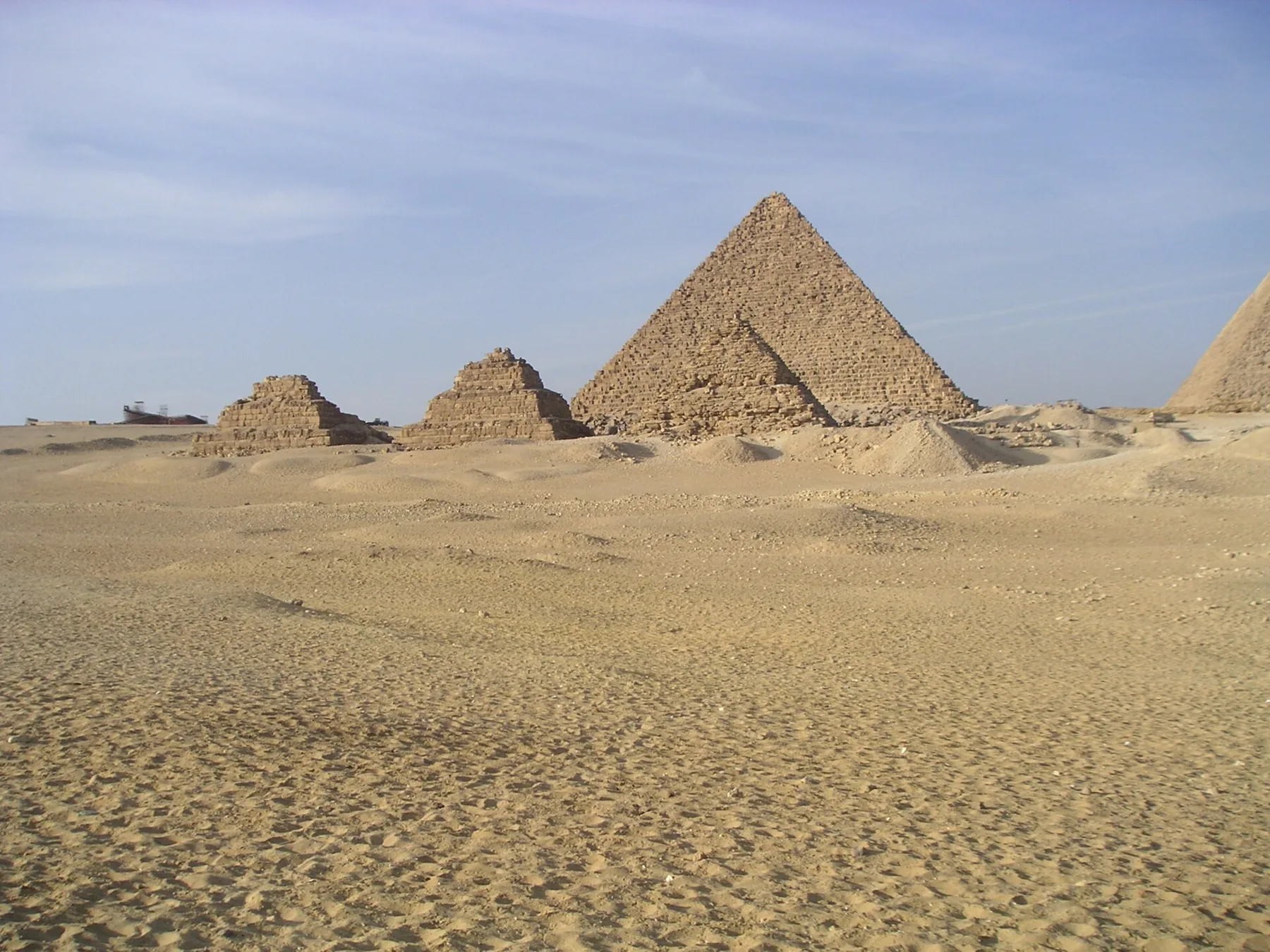
The smallest of the three Giza pyramids, and the most revealing, because it was never finished. Menkaure died before his builders were done, and his successor completed the complex in mudbrick. What was left behind is, in Mark Lehner's words, a "frozen" moment in the life of a building site.
The Ministry of Tourism and Antiquities gives its original height as 65 m, with a base less than a quarter of his predecessors'. Lehner puts its mass at about a tenth of Khufu's pyramid. The question it answers is what the pyramid-builders were in the middle of doing when the work stopped.
History
Menkaure was probably Khafre's son and Khufu's grandson. Why he built smaller is not known. Perhaps the plateau was running out of room; perhaps, Lehner suggests, the emphasis was shifting from the pyramid as the king's tomb to the temples and their endowments, for while pyramids shrank through the rest of the Old Kingdom, mortuary temples grew in size and expense. The complex still used a great deal of granite, far more costly than limestone: the lower courses of the pyramid were cased in red granite brought from Aswan, over 800 km away.
After at least 26 years of rule, Menkaure died with the work in progress. In the mortuary temple, Lehner describes the masons caught in the act of fitting granite casing blocks along a corridor, cutting back the limestone core to take them. His successor Shepseskaf covered the unfinished work in plastered, whitewashed mudbrick, and when George Reisner stripped it away he found bright red paint on the core blocks: levelling lines, measurements and the names of the work gangs. The largest block in the temple weighs over 200 tons, the heaviest known at Giza. The king's cult continued here for some three hundred years after his death.
Reisner won the right to excavate here in 1899, when archaeologists drew lots for Giza on the balcony of the Mena House Hotel. He guessed that the smallest pyramid would have the richest temples, and he was right: in the valley temple he found the famous pair statue of Menkaure in the embrace of his queen Khamerernebty II, and the triads showing the king striding between the goddess Hathor and a god of one of Egypt's provinces, which Lehner ranks among the greatest pieces of ancient Egyptian art.
Inside the pyramid, the explorer Howard Vyse found a dark stone sarcophagus carved with palace-façade panelling. It was shipped to England and lost when the ship carrying it, the Beatrice, sank.
What you actually see
Go to the north face. At the bottom, the red granite casing blocks were left undressed, still rough and still carrying the handling bosses the workers used to move them, except for patches smoothed around the entrance. Above them runs a great gash in the pyramid's face. In AD 1196 Othman, a son of Salah al-Din, set out to dismantle the pyramid for its stone; after eight months' work he had only damaged its north face. South of the pyramid stand three small queens' pyramids, two of them stepped, either by design or left unfinished.
Inside, a passage leads down to a chamber carved with a repeated tall false-door motif, the first purely decorative element inside a pyramid since Djoser's.
Practical
The Ministry listing read on 19 September 2026 gives opening hours of 07:00 to 17:00. Entry inside the pyramid needs its own ticket in addition to the Giza area ticket. Recheck before visiting.