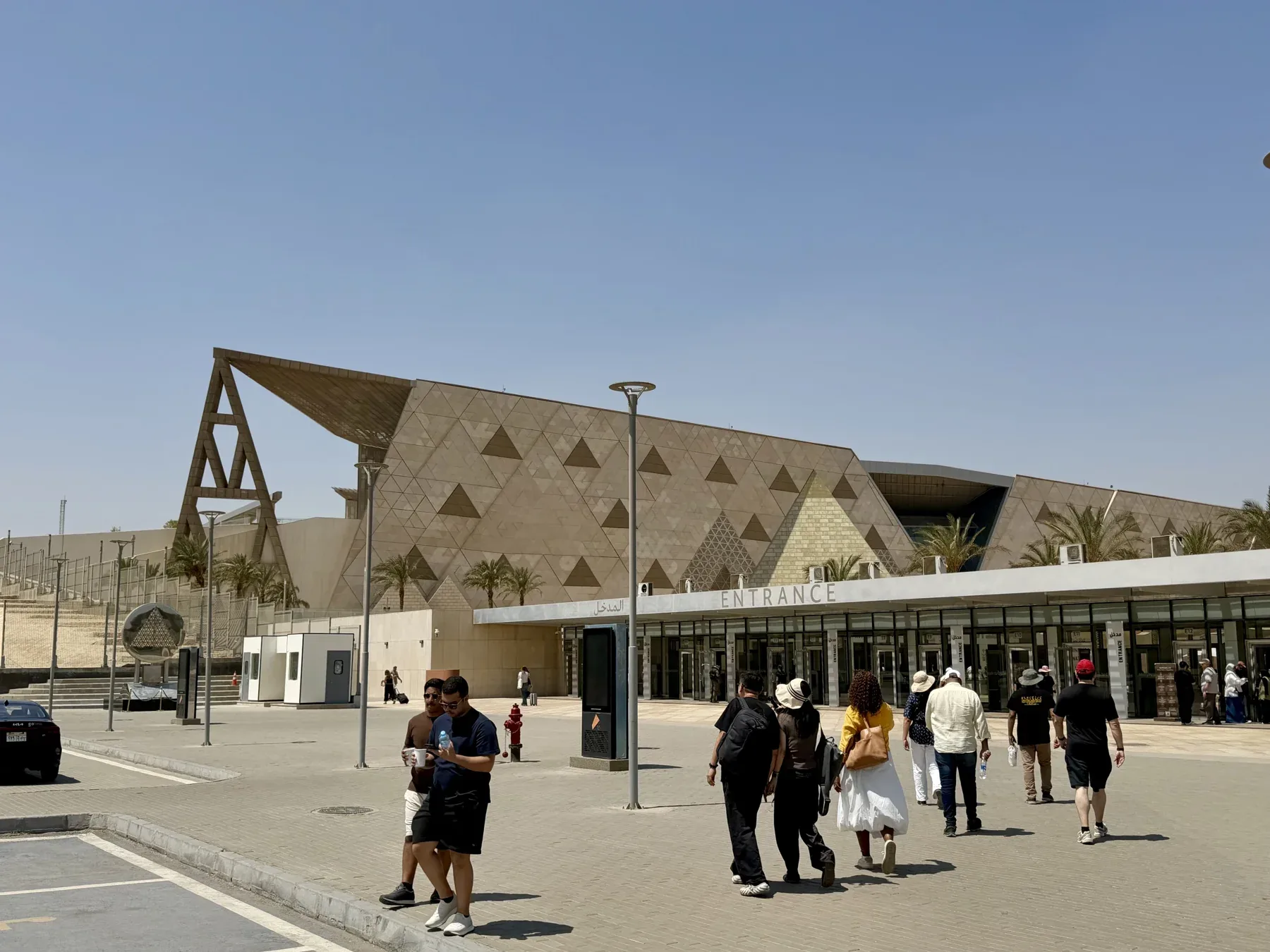
What it is
The museum on the edge of the Giza plateau, which describes itself as the world's largest museum dedicated to a single civilisation. Its official site lists the Tutankhamun Galleries, the Main Galleries, the Grand Hall, the Grand Stairs and Khufu's Boats Museum among the areas a ticket opens.
A museum is always a second setting for its objects. What makes this one different is that two of its greatest collections belong to places you can see on the same day: Khufu's pyramid, just up the road, and the Valley of the Kings, where Tutankhamun's burial lay untouched for more than three thousand years. The question to carry through it is what happens to an object when it leaves its tomb.
History
In November 1922 Howard Carter's party broke into the tomb of Tutankhamun. Toby Wilkinson recounts that they found bouquets of flowers left over from the royal funeral, and that the king's burial had been undisturbed for thirty-three centuries. Those flowers have become a scientific archive in their own right. The botanist Newberry studied the funeral garlands, made of olive, papyrus, lotus, cornflower, willow, celery and date palm, and the Oxford Handbook calls the tomb's plant material still one of the most valuable sources for anyone studying the flora of ancient Egypt.
Khufu's boat has an equally long journey. In 1954 two sealed pits were found on the south side of the Great Pyramid. The first held a great cedarwood boat, dismantled into 1,224 pieces but laid out in the shape of the finished vessel. The master restorer Ahmed Youssef lifted it piece by piece and, after years of work, rebuilt it: 43.3 m long, its planks "stitched" together with rope through U-shaped holes. In 1985 a camera lowered into the second pit confirmed that it held another boat. Mark Lehner argues that the boats were not symbolic vessels for the sky but objects from Khufu's own funeral, too charged to leave in use, dismantled and buried just outside his precinct.
The museum is also a laboratory. The Oxford Handbook describes its conservation laboratories as "a reason for envy in the scientific community", and hopes they may answer the many open questions about the textiles from Tutankhamun's tomb. The same volume asks a question worth taking in with you: who the museum is for, now that visitors from Asia and the Gulf far outnumber those from the West.
What you actually see
Choose before you arrive. In our judgement the museum rewards two long looks more than twenty short ones: the Tutankhamun Galleries, where the king's burial goods have galleries of their own; and Khufu's boat, a ship from the reign that built the Great Pyramid. For each object you stop at, read the label for date, material and findspot, and connect it to the place you saw it came from.
Practical
The official ticketing site read on 19 September 2026 gives the galleries' hours as 09:00 to 18:00 on Sunday, Monday, Tuesday, Thursday and Friday, and 09:00 to 21:00 on Wednesday and Saturday, with last entry one hour before the galleries close. The wider complex opens at 08:30. The official ticketing site is the only one the museum recognises, and it also sets photography rules, including designated areas in the Tutankhamun Galleries. Recheck before visiting.
