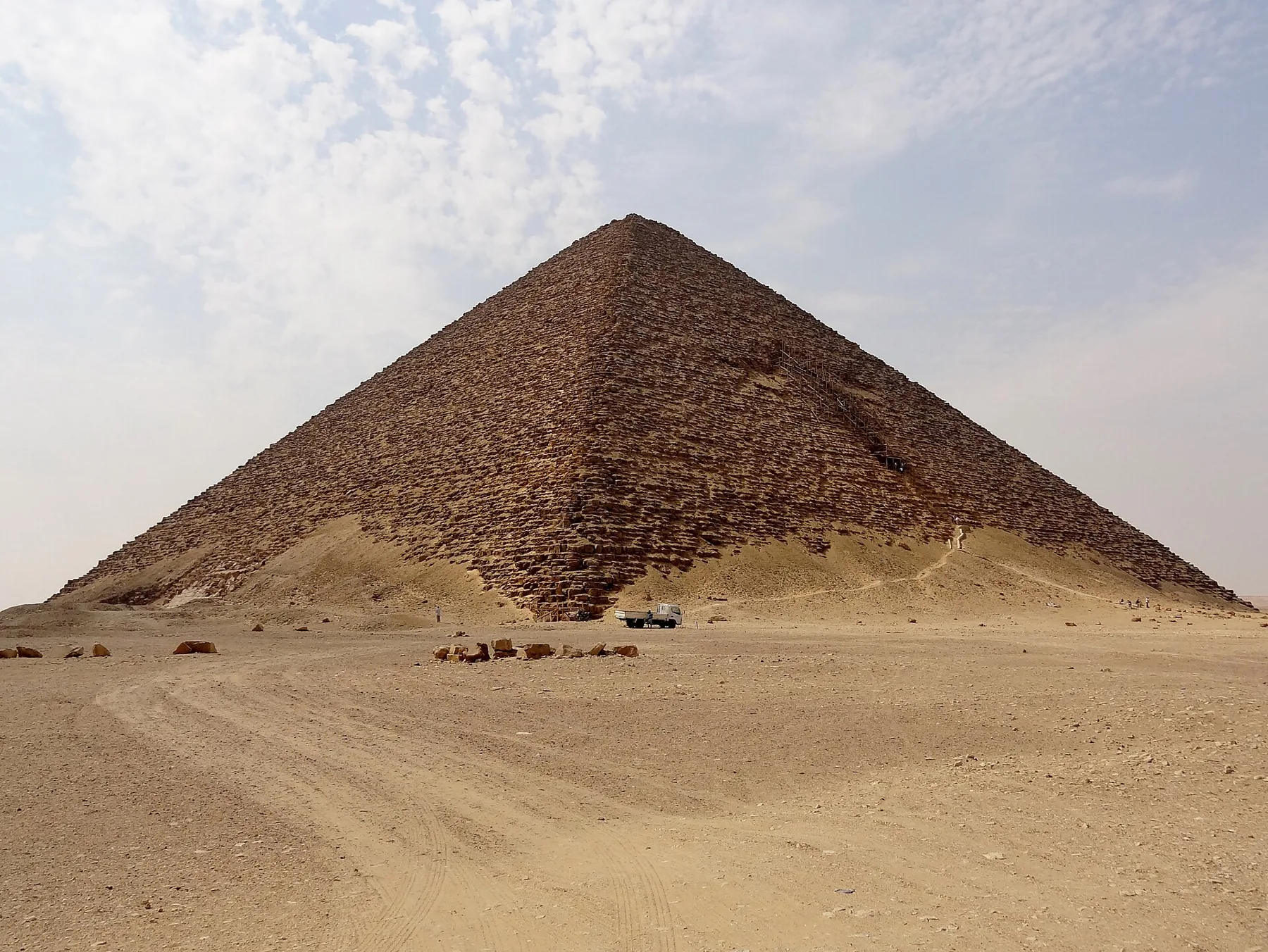
What it is
The first pyramid that worked. After the Bent Pyramid began to fail, Sneferu's builders started again a kilometre to the north, and this time they chose the gentle slope from the start. The Ministry of Tourism and Antiquities ranks it the third-largest Egyptian pyramid, after those of Khufu and Khafre at Giza, and it was probably the king's tomb.
Mark Lehner calls it a neatly planned and executed construction, with none of the struggle visible next door. The question it answers is how long it took to build a pyramid, because here, unusually, the builders left dates on the stones.
History
Sneferu began the North or Red Pyramid in around the thirtieth year of his reign, at the slope of about 43 degrees his builders had been forced into at the top of the Bent Pyramid. Its name comes from the reddish colour of its stone; the Ministry notes it was once cased in white limestone from Tura, south of Cairo, which was reused in medieval times.
Excavating the debris at its foot, Rainer Stadelmann found hundreds of pieces of that fine casing, many with graffiti left by the work gangs on their hidden faces. One, from a corner, records "bringing to earth" in a year that corresponds to about the thirtieth year of the reign. About thirty courses higher, Stadelmann placed a casing stone dated only four years later, which Lehner says gives a very clear picture of how long such a pyramid took to build. Stadelmann also found pieces of the capstone: a plain block of good limestone, uncarved, discarded at the base by the people who stripped the casing.
Inside, the burial chamber is no longer cut into the ground. It is built high in the body of the pyramid, reached from two tall antechambers with corbelled roofs, and Lehner reads the effort to lift the chamber into the pyramid, from Sneferu to Khufu, as a reflection of the king's growing identification with the sun. Fragments of human remains were found in the chamber; it has not been established whether they are royal. The mortuary temple seems to have been finished in a hurry, perhaps by Khufu at his father's death.
What you actually see
A broad, low pyramid of reddish stone. Lehner gives its base as 220 m and its height as 105 m. The Ministry describes the way in: an entrance on the north side, a passage about a metre high and a metre wide sloping down to a chamber with a corbelled roof like an inverted stairway, a second chamber beyond, and a third, higher chamber believed to be the burial chamber. The corbelled roofs are, in Lehner's words, of great finesse, far in advance of those at Meidum. The capstone has been reconstructed in the temple enclosure at the pyramid's foot.
Practical
The Ministry listing read on 19 September 2026 gives opening hours of 08:00 to 17:00. Recheck before visiting. The passage is long, low and steep: in our judgement it is not for anyone uncomfortable bending and climbing in a confined space.
_04.jpg)