What it is
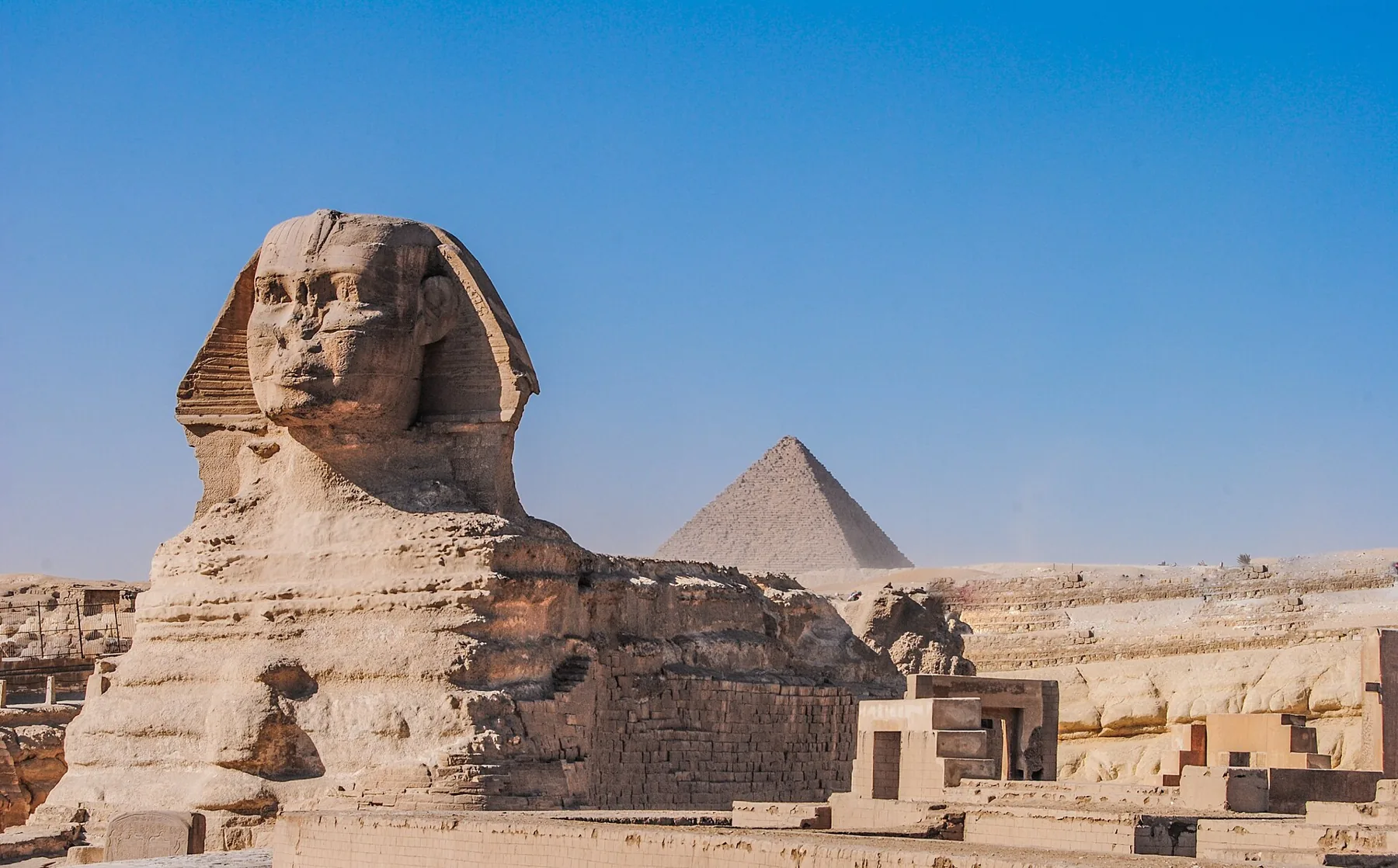
A king's head on a lion's body, cut from the living rock at the foot of Khafre's causeway. Mark Lehner calls it the first truly colossal sculpture in ancient Egypt, carved at 22 times life size for the body and 30 times for the head; nothing on that scale was made again for some 1,200 years. The lion was a sign of royal power; the human head, wearing the striped nemes headdress only kings could wear, was the king's intelligence in command of it.
It is also a magnet for myth. The question worth asking is the one the evidence can answer: how was it made, and what did the Egyptians who came after Khafre think it was?
History
The Sphinx was not built; it was quarried. Khafre's builders cut a U-shaped ditch into the bedrock, leaving a block standing in the middle, and sculpted the lion from it. The stone they removed went into the temples beside it, and geologist Thomas Aigner's study of the rock layers let Lehner's team match blocks in the temple walls to the layers they came from in the Sphinx's body. That same geology explains its odd proportions. A great fissure runs across the thinnest part of the body, and Lehner thinks the carvers lengthened the lion to get round it: the head is not too small, the body is too long. The Ministry adds that the Sphinx's face closely resembles Khafre's statues, and that his valley temple was finished before the Sphinx was begun.
In front of it, Khafre began a temple for the Sphinx and never finished it. No Old Kingdom text mentions either the statue or its temple, and Lehner suggests its service may never have begun. Working there, he noticed that at the equinoxes the sun seen from the temple sets at the southern foot of Khafre's pyramid, along the temple's axis, so that the shadows of the Sphinx and the pyramid merge; and that at the summer solstice it sets between the two largest pyramids, drawing the hieroglyph for "horizon" across the sky, "whether by chance or by design".
Eleven centuries later the Sphinx was rediscovered as a god. In the Eighteenth Dynasty it was seen as the sun god, Horemakhet, "Horus in the Horizon". Thutmose IV set up the Dream Stela between its paws: as a prince, it says, he fell asleep in its shadow, with sand up to its neck, and the Sphinx promised him the throne if he cleared it and repaired its body. The stela is itself a reused lintel taken from Khafre's own temple, and its picture of the Sphinx on a pedestal with a door, most likely an artistic device, has fed the persistent legend of a hidden passage beneath the statue. Repair work on the Sphinx has gone on ever since, from those New Kingdom blocks to Roman patching with small brick-sized stones and the modern campaigns of the twentieth century.
What you actually see
Look at the layers. The head is carved from a harder, better stone than the soft body below it, and the base from a fossil coral reef, which is why the parts are so differently preserved. On the paws and chest you can see the casing of later repairs, in different stones and different centuries. Between the paws stands the Dream Stela. Our suggestion is to look at the Sphinx from the side as well as the front: that is where the long body, the ditch it was cut from and the temples built of its stone all make sense together.
Practical
The Ministry listing read on 19 September 2026 lists the Sphinx itself as "private visits only plus site opening fees". Confirm with the site which viewing areas the Giza Plateau ticket covers before travelling.