What it is
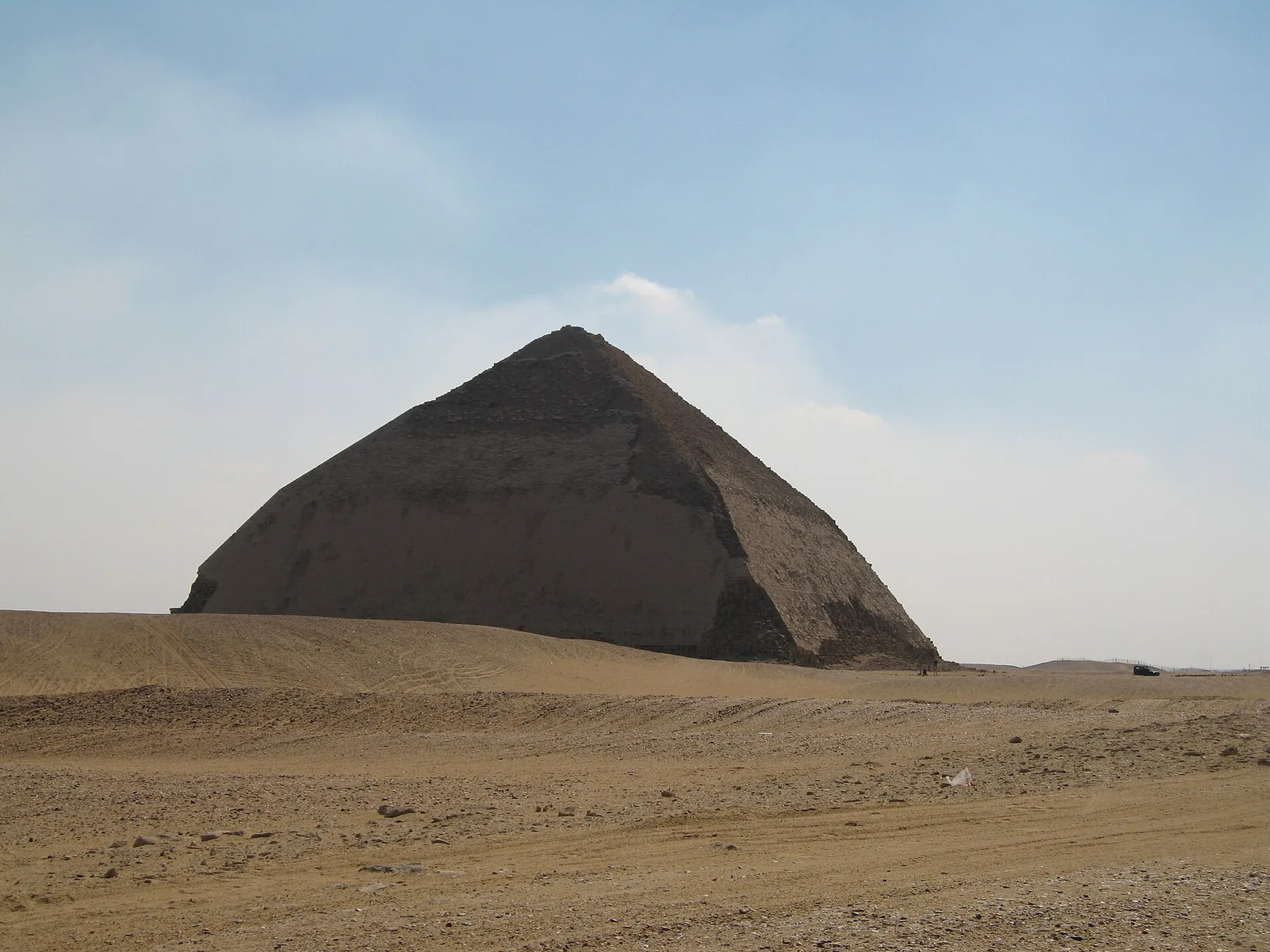
A pyramid that changes its mind halfway up. The Bent Pyramid of Sneferu rises at a steep angle, then abruptly flattens, and the break is not a design: it is a rescue. The Ministry of Tourism and Antiquities describes a start at about 55 degrees and a change to 43 because the structure was becoming unstable.
It keeps more of its fine outer casing than most pyramids, so it is the easiest place to picture the smooth white skin a pyramid once had. The question it answers is the one Sneferu's builders faced: what do you do when your pyramid starts to crack?
History
When Sneferu left Meidum for Dahshur, Mark Lehner points out, there was as yet no blueprint for a true pyramid. The step pyramids before it had faces of about 72 to 78 degrees, far too steep. Evidence inside the core suggests the Bent Pyramid began as a smaller pyramid at about 60 degrees. Subsidence soon set in, and the builders added a girdle around the stump to bring the slope down to just under 55. It still was not enough. The early stages were laid the traditional way, with the stones sloping inwards, and about halfway up the builders began laying the courses flat: they had found that the leaning courses increased the stresses rather than easing them. The upper part was finished at about 43 degrees, which gave the pyramid its bend.
Lehner puts the failure down to three things together: a lack of good mortar, carelessly laid core blocks with gaps filled by debris, and above all the unstable desert surface beneath. Toby Wilkinson describes the result as "a completed pyramid, but a seriously botched job", which left the king's engineers in no doubt that they had to start again. They did, a little to the north, and built the Red Pyramid.
Sneferu was probably not buried here. Yet the Bent Pyramid, the complex that tested its builders' nerves the most, became the centre of his cult for centuries.
What you actually see
First, the bend, best seen from a distance. Then the casing: the fine limestone survives on large parts of the faces, and you can see where plunderers stripped it from the corners, working from the bottom up.
The pyramid is unique in having two sets of chambers, entered from the north and from high on the west side, each with a corbelled roof. The upper, western chamber shows the instability again: it was completely shored up with scaffolding of great cedar beams. Some time after both chambers were built, someone who knew exactly where they lay hacked a passage through the masonry to join them. Why Sneferu wanted two systems is not known; Lehner reports one suggestion, that the western system echoes the South Tomb of Djoser at Saqqara.
To the south stands a small satellite pyramid, built with horizontal courses. Lehner calls it an important link to the Great Pyramid of Khufu: its passage rises into a miniature version of the Grand Gallery.
Practical
The Ministry listing read on 19 September 2026 gives opening hours of 08:00 to 17:00. Recheck before visiting. Whether the interior is open on a given day should be confirmed locally.
.jpg)