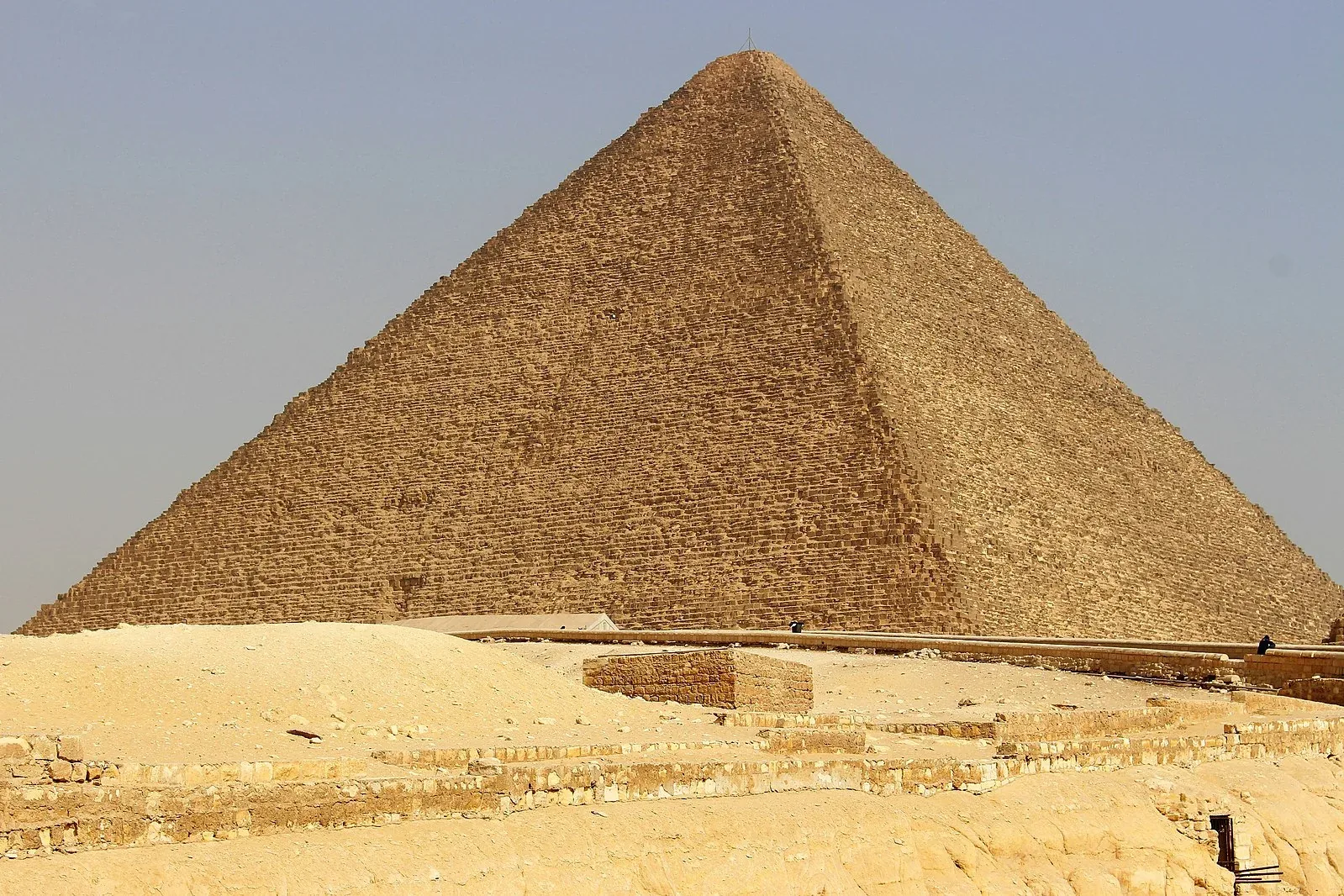
What it is
The tomb of Khufu, Sneferu's son and successor in the Fourth Dynasty. It is the largest pyramid in Egypt and the last surviving member of the Seven Wonders of the Ancient World.
When finished it rose about 146.6 m on a square base about 230 m a side. Its sides deviate from the cardinal directions by an average of only about three minutes of arc, a twentieth of a degree.
History
Khufu came to the throne in the twenty-sixth century BC. The Oxford History of Ancient Egypt dates his reign to 2589–2566 BC, and Mark Lehner places his accession around 2551 BC. Little is known about the man himself. The only certain image of him surviving from his own time is an ivory figurine about 7.6 cm high, found at Abydos, with his Horus name on the throne.
Three bodies of evidence show how a monument like this was built and supplied.
The first is the workers' town at Heit el-Ghurab, at the south-south-east edge of the Giza plateau. Lehner's team began excavating there in 1988 and found bakeries full of bread moulds and a building used to process fish. Barry Kemp notes that the excavated town belongs mainly to the reigns of Khafre and Menkaure, above earlier building likely to date to Khufu. Toby Wilkinson places the main settlement of Khufu's own reign near his valley temple.
Who did the work is described in the same sources. In Wilkinson's account most workers were temporary, serving a few months before going home, while a smaller body of specialists lived at the site year-round. Lehner describes the mass of the workforce as crews of peasant conscripts organised into named gangs, such as "Friends of Khufu", and gives 20,000–30,000 as the generally accepted total.
The second is the Wadi el-Jarf papyri, found in 2013 at an ancient port on the Red Sea coast and dated to the twenty-seventh year of Khufu's reign. Among them is a logbook kept by an inspector named Merer, who led a team of about 200 workmen. Many of its entries concern building the Great Pyramid, work at the limestone quarries at Tura across the river, and moving stone blocks to the pyramid by the Nile and canals. The pyramid's outer casing was Tura limestone.
The third is muon imaging by the ScanPyramids project. In 2017 it reported a large void above the Grand Gallery, with a cross-section similar to the Gallery's and at least 30 m long; its role is unknown. In 2023 the team characterised a corridor-like structure about 9 m long and 2 m by 2 m in section, and an endoscope inspection later confirmed it.
What you actually see
From the outside you see core masonry. The fine white Tura limestone casing was stripped off long ago; at the top of Khafre's pyramid next door, casing blocks still survive.
Inside, the Ascending Passage is about 1.05 m wide and only a little taller, a cramped climb. It opens into the Grand Gallery, 46.7 m long, 2.1 m wide and 8.7 m high, with a corbelled roof. In our judgement the Gallery is the reason to go inside.
At the top is the King's Chamber, built entirely of red granite, with Khufu's red granite sarcophagus. Petrie noted that the sarcophagus is fractionally wider than the doorway, so it must have been put in place while the pyramid was being built. Above the chamber are five stress-relieving chambers, where graffiti left by the work crews combine gang names with the king's.
Practical
- Open 07:00-17:00 daily, per the Ministry listing read on 2026-09-14.
