What it is
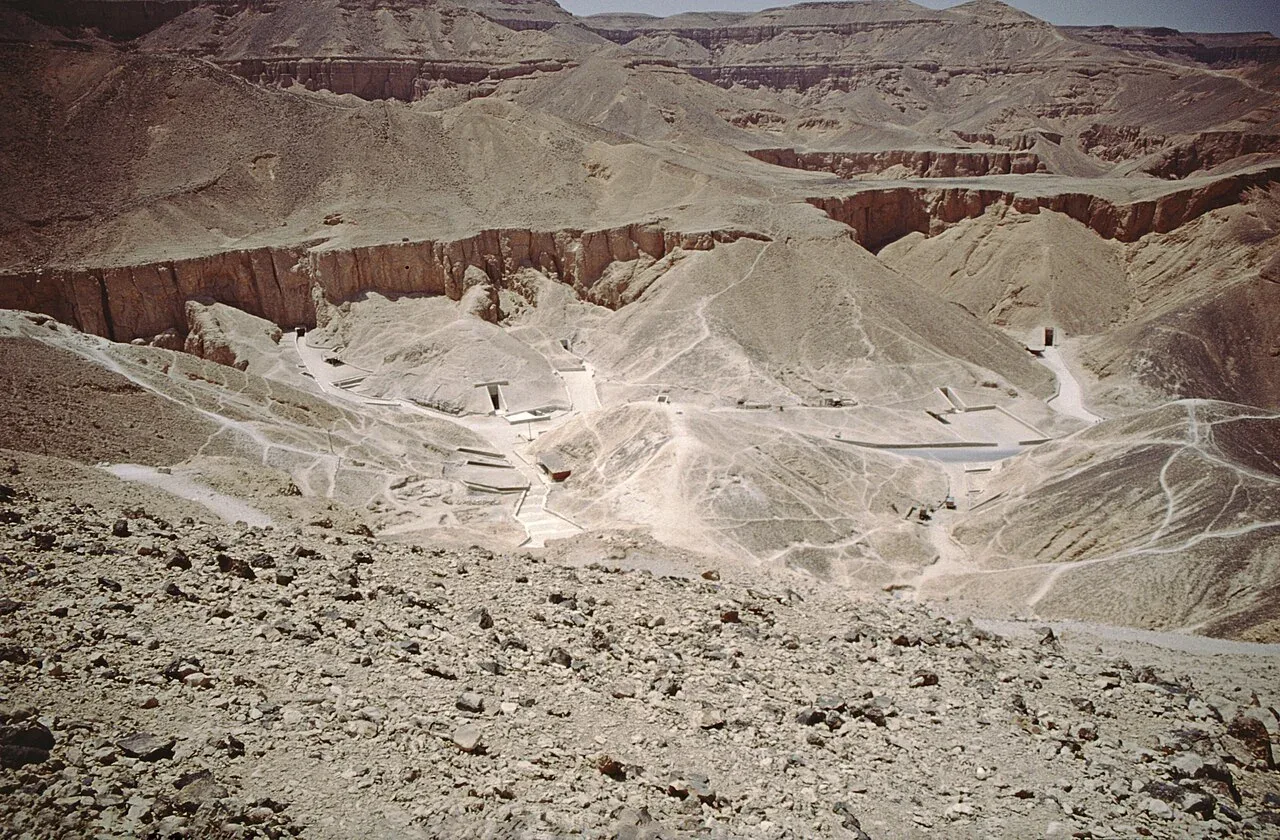
The royal cemetery of the New Kingdom: a dry river valley in the hills of the west bank, across the river from Thebes, modern Luxor. The rulers of the Eighteenth, Nineteenth and Twentieth Dynasties, c. 1550–1069 BC, were buried here, together with some members of the royal family and a few non-royal officials of very high rank. The valley holds more than sixty tombs, and some twenty more unfinished pits.
Above it rises a pyramid-shaped peak. The official monuments listing links the pyramid form with rebirth and eternal life, and records that the area and the peak were sacred to a funerary aspect of the goddess Hathor, the "Mistress of the West".
History
From the beginning of the Eighteenth Dynasty, kings stopped building pyramids in the Memphite region and put their tombs at Thebes, and their successors did so to the end of the Twentieth Dynasty. Barry Kemp describes what changed. The royal tomb became a catacomb cut into the desert hills, its security depending mainly on careful policing. The offering cult moved to a separate temple at the edge of the floodplain.
The first king confirmed to have been buried in the valley is Thutmose I. Even his burial is debated: his name appears on sarcophagi from two tombs, KV 20 and KV 38, and there is no agreement on which came first.
The tombs did not stay safe. Under Ramesses IX, robbers broke into the tomb of Ramesses VI a decade after it was sealed. People from the workmen's village, who knew the necropolis intimately, were among the thieves. One of the tomb-robbery papyri lists gold and silver recovered from "the thieving workmen of the Necropolis". The Abbott Papyrus records a Twentieth Dynasty judicial enquiry into tomb robbery.
Then the state itself emptied the valley. From 1066 BC, under the military rulers of Thebes, the royal tombs were cleared one by one over about a decade, and the operation was officially presented as restoration. Around 1050 BC the royal mummies were gathered into the tomb of Amenhotep II, KV35, and others into a secondary cache in the tomb of a Seventeenth Dynasty queen. The cache found at Deir el-Bahri and cleared in 1881, in the tomb usurped by Panedjem II (TT320), held a large number of looted royal mummies.
The best-known exception is Tutankhamun, who died in 1322 BC before he was out of his teens. Howard Carter entered the corridor of his tomb on 26 November 1922. Even here robbers had broken in during antiquity: a darker patch of plaster on a sealed blocking wall showed where.
The texts in the royal tombs are about renewal. Following Erik Hornung, Jan Assmann describes the Books of the Netherworld as concerned above all with regeneration and the reversibility of time. Each night the sun god descends into the depths to unite with his corpse and renew himself. The Amduat follows the twelve hours of that night, and the Litany of Re is recorded only in royal tombs.
What you actually see
Look up for the pyramid-shaped peak above the valley. The tombs below it are catacombs cut into the hills, and their texts follow the sun's journey through the night.
Practical
- Open 06:00-17:00, per the Ministry listing captured on 2026-09-03. The page read on 2026-09-14 did not show visiting details, so check the listing before you go.
