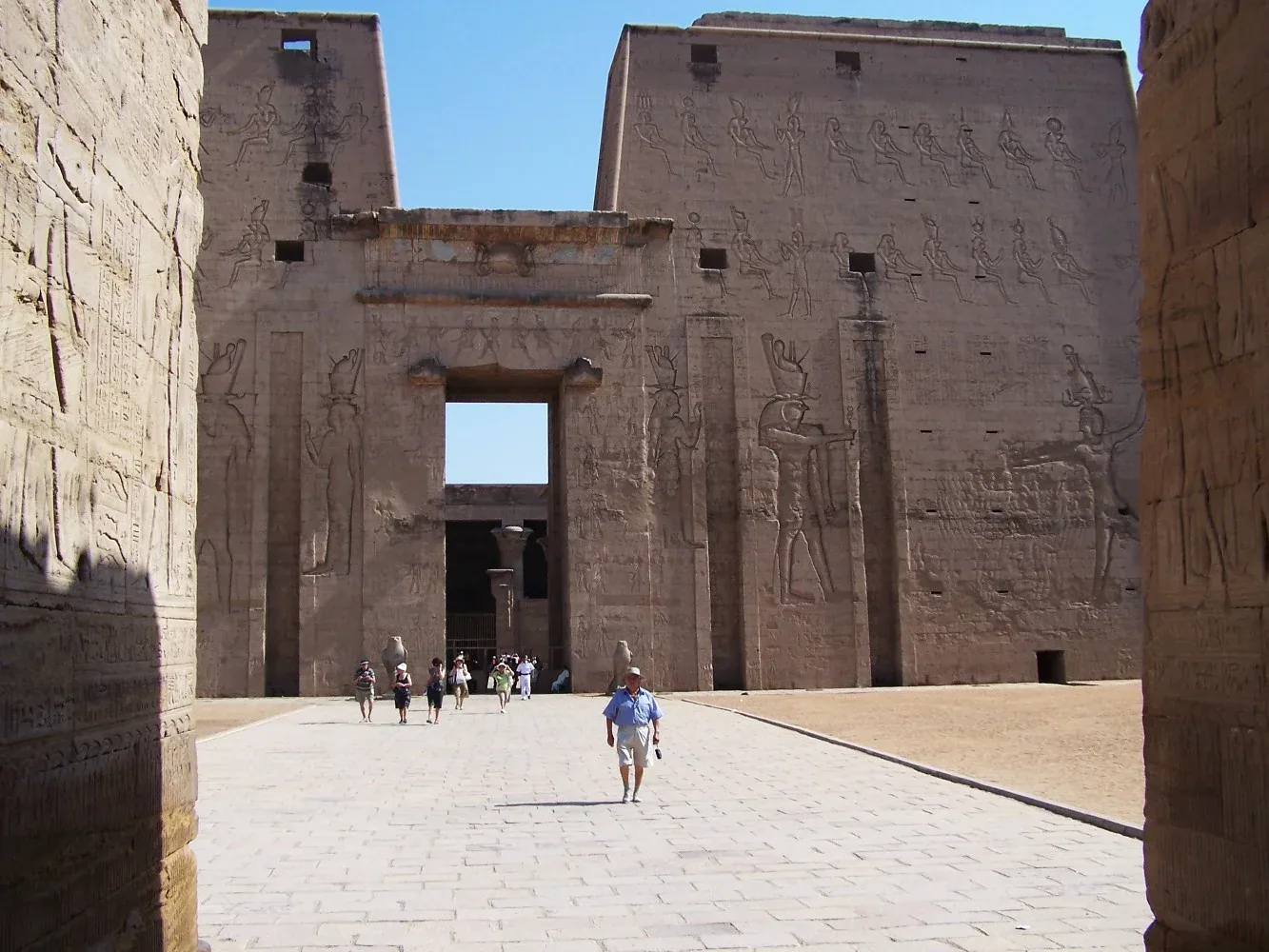
What it is
The temple of the falcon god Horus at Edfu, ancient Djeba. It was built under the Ptolemies between 237 and 57 BC and dedicated to Horus of Behdet. The official listing calls it one of the most striking and complete of Egypt's temples; Richard H. Wilkinson calls it the most complete and best preserved of them all.
Edfu was the traditional setting of the mythological battle between Horus and his enemy Seth, and the temple's walls return to that story again and again.
History
Horus was worshipped here long before the Ptolemies. Barry Kemp notes that a Horus cult at Edfu had become prominent by the early Middle Kingdom and stayed so into Ptolemaic and Roman times. The place names Behdet and Mesen came to be used as synonyms for Edfu. Nectanebo I of the Thirtieth Dynasty gave generously to Horus at Edfu, which Toby Wilkinson calls the god's principal cult centre.
The Ptolemaic temple replaced a New Kingdom one oriented east to west; the new building runs south to north. Because an unusually large number of building inscriptions survive, its history is known in detail. Ptolemy III began it in 237 BC. The inner temple and its decoration were finished in 207 BC, but unrest in Upper Egypt, especially under Ptolemies IV and V, delayed its dedication until 142 BC. The hypostyle hall followed, completed in 122 BC, and the peristyle court and the entrance pylon were finished in 57 BC under Ptolemy XII, father of the last Cleopatra.
The Ptolemies built new, but not from nothing. In the sanctuary they kept the stone shrine of Nectanebo II, the last native king, which Alan Lloyd reads as a deliberate affirmation of continuity with Egypt's past.
The walls are a library turned outwards. Kemp describes the scenes and texts as extracts from, or summaries of, longer books that must have been kept in the temple's library, and notes that they are far more informative about mythology and cult than earlier temples. Olaf Kaper lists what they include: ritual texts, festival calendars, hymns, recipes for sacred oils, building inscriptions, and instructions to priests entering the temple. The small laboratory room carries two recipes for kyphi, a temple incense, cut into its walls.
The temple survived so well, the official listing says, because it lay buried under layers of settlement debris for millennia. Auguste Mariette uncovered and restored parts of it in 1860.
What you actually see
The entrance pylon rises in two towers that were planned as near mirror images of each other, each carved with Ptolemy XII striking down his enemies. Two falcon statues of Horus flank the gate. Behind the pylon, at the base of the walls, scenes show the Feast of the Beautiful Meeting, in which Horus of Edfu was united with Hathor of Dendera.
The peristyle court has a colonnade of columns with paired capitals of varied forms. Before the hypostyle hall stands a colossal granite statue of Horus as a falcon wearing the double crown.
Inside, two hypostyle halls of twelve columns each lead to offering halls and the sanctuary, which still holds Nectanebo II's shrine, cut from a single block of granite about 4 m high. Richard H. Wilkinson calls it grey granite; Kemp calls it black granodiorite. Chapels surround the sanctuary, and one holds a modern reproduction of the god's sacred boat.
Walk the narrow ambulatory between the temple and its enclosure wall. There the walls carry a mythical foundation text and the ritual drama in which Horus defeats Seth, shown as a hippopotamus, with ten harpoons. Emily Teeter notes that stairways to the roof are lined with processions of priests, and Wilkinson that only the western stair can now be used.
South of the temple stands the birth house, with figures of Bes and scenes of the infant Harsomptus, son of Horus and Hathor, nursed by goddesses.
Practical
- The Ministry listing read on 2026-09-14 gives opening at 06:00 or 07:00, depending on its schedule, and closing at 17:00.