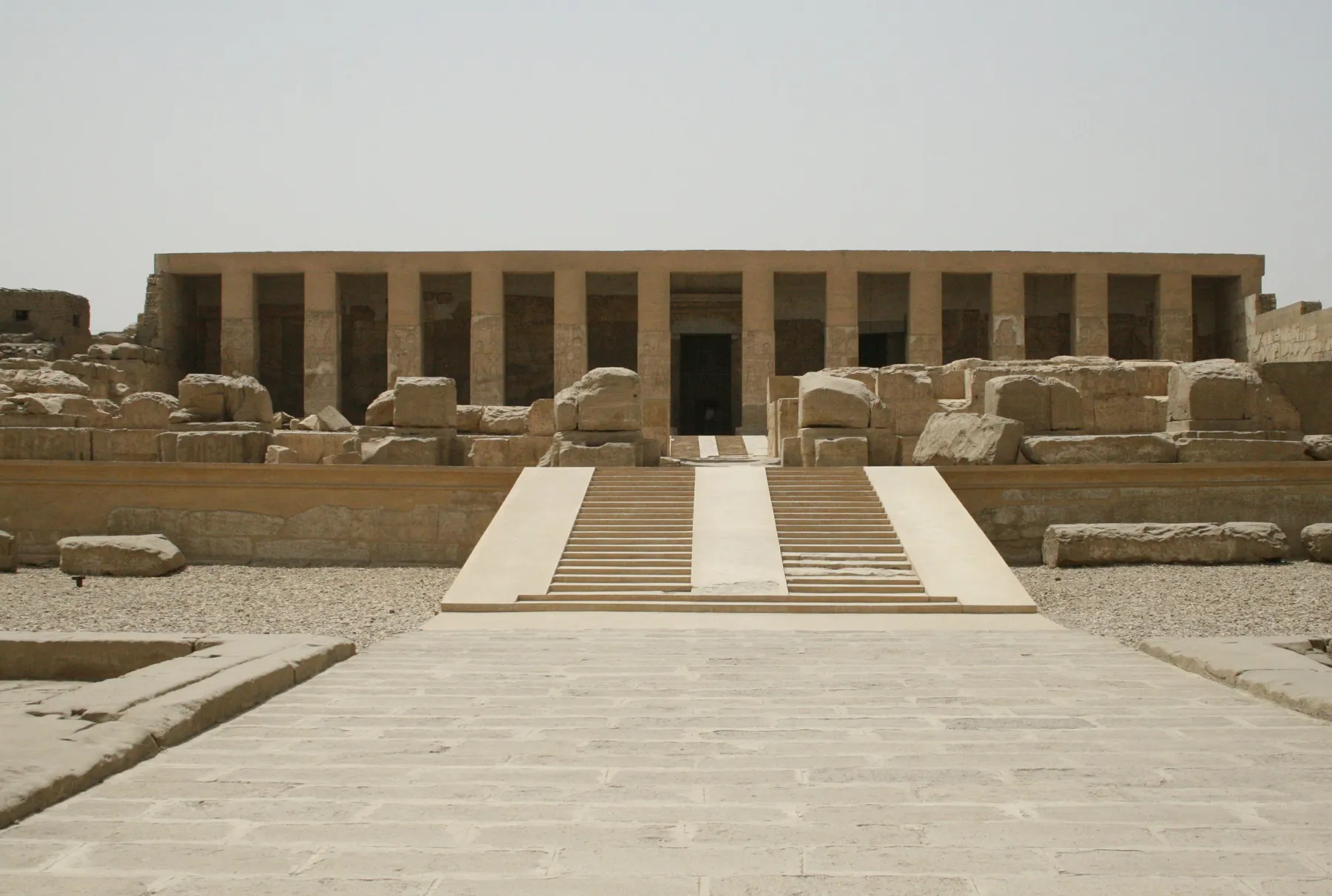
What it is
Abydos was the holy city of Osiris, the god of the dead. It was held to be his burial place, and Egyptians from all over the country wanted to be buried here, or at least to leave a memorial. The Temple of Seti I, begun by Seti and completed by his son Ramesses II, is its great surviving building. It was built of fine white limestone, the Greeks called it the Memnonium, and Richard Wilkinson counts it among the most impressive religious buildings in Egypt.
The question to carry inside: why would a king build his finest temple in the one place every Egyptian hoped to be near in death?
History
Abydos was old long before Seti. It is the oldest known sanctuary of Osiris, and the tomb of Djer, a king of the First Dynasty, was venerated as the tomb of Osiris himself from at least the New Kingdom. To build here was to build beside the god of resurrection.
Seti's temple outlived his dynasty by more than a thousand years. Under the Ptolemies it dominated Abydos. Its cult turned towards Serapis, pilgrims came, and Ptolemy IV added a pylon facing the desert. In Roman times it housed a popular oracle of the god Bes, whose visitors left graffiti on its walls. The oracle's messages became subversive enough that the temple was forcibly closed in 359 under the emperor Constantius II, as the historian Ammianus Marcellinus records.
What you actually see
The temple is unique in having seven chapels at its heart, for the deified Seti I, Ptah, Re-Horakhty, Amun, Osiris, Isis and Horus. Seven doorways once opened onto seven processional paths leading to them, but most were filled in when Ramesses added the outer parts of the temple. Six chapels end in false doors. The seventh, Osiris's, has a real door, into a suite of rooms for him behind the whole row, with a secret crypt where the temple's treasures were probably kept.
Look at the carving. The raised reliefs made in Seti's own reign rank, in Wilkinson's judgement, with the finest in any Egyptian temple, down to the smallest hieroglyphs. The decoration added for Ramesses is mostly in less accomplished sunk relief.
Then find the narrow passage in the south wing. On one wall, Seti and the young Ramesses make offerings to their ancestors: 75 kings, each named in a single cartouche, with Seti himself as the 76th. It is one of the few Egyptian king lists to survive, and it begins with Menes, the founder of Egypt. It is also edited. Kings of weak or divided times are missing, and so are the kings of the Amarna Period. Barry Kemp reads it as a way of legitimising the present by revering an edited version of the past. On the opposite wall, the young Ramesses lassoes a bull with his father.
Behind the temple, on the same axis, lies the Osireion, a cenotaph of Seti built in the form of a royal tomb and decorated mainly by his grandson Merenptah. Wilkinson describes a hall of granite, about 30 by 20 metres, where a false sarcophagus and canopic chest stood on an island surrounded by groundwater, the primeval waters from which creation rose. Its walls carry texts from the Book of Gates and a figure of the sky goddess Nut. It was a symbolic tomb of Osiris, and the answer to the question: the king built his temple in front of the god's own tomb.
Practical
Abydos is usually visited from Luxor together with Dendera. In our judgement, ask your guide to include the Osireion behind the temple: it explains why the temple is here.
.jpg)