What it is
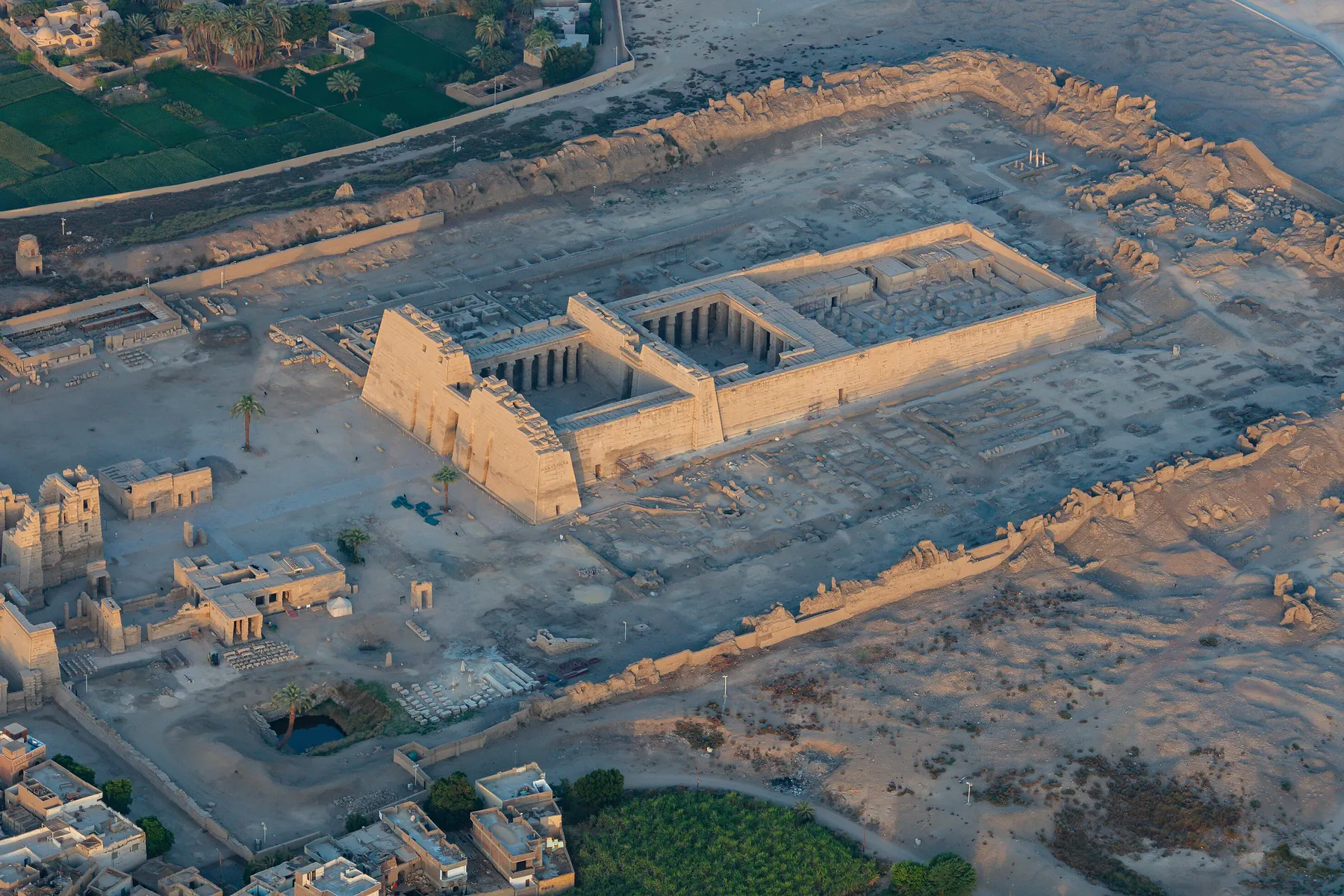
Medinet Habu is a walled estate on the West Bank at Luxor. At its centre stands the mortuary temple of Ramesses III (c. 1184–1153 BC), and around it are smaller temples and chapels from before and after his reign. Richard Wilkinson counts the main temple as the best preserved of all the mortuary temples of Thebes, with more than 7,000 square metres of decorated walls. The Ministry notes that it was closely modelled on the Ramesseum, the temple of Ramesses II.
The question to carry inside: why did a temple built for a dead king end up as a fortress, an office and a town?
History
The ground was holy before Ramesses built on it. The Egyptians called the place Djamet. Popular belief held that it was the burial place of the Ogdoad, the eight primeval gods, and in the New Kingdom the god Amun of Luxor crossed the river every ten days to perform their funerary rites and so renew creation itself.
Ramesses III fought the Libyans and the Sea Peoples, and late in his reign he fell victim to a conspiracy in the royal harem. Wilkinson thinks the attempt on his life was probably made in the upper rooms of the temple's gatehouse. The plot was discovered and the conspirators tried, but the king died during the trial, and it is not known whether the attack killed him or natural causes did.
His temple outlived his cult because it was useful. During his reign and after, Medinet Habu was the administrative centre of western Thebes. In his 29th year, about 1165 BC, the grain that paid the workmen who cut the royal tombs was late and short. The scribe Amennakhte carried their formal complaint to the Temple of Horemheb, part of the Medinet Habu complex, and later that year the two gangs stopped work and staged sit-ins at the royal mortuary temples until their rations were paid. Nicholas Reeves and Richard Wilkinson call it the world's first known labour dispute.
When civil war engulfed Upper Egypt after the end of the Twentieth Dynasty, the people of the West Bank took refuge inside its walls. The walls were eventually breached. In the Christian era the Coptic town of Djeme covered the whole site, houses filled the temple, and one of its courts became a church.
What you actually see
You enter through the High Gate, built like a western Asian fortress gate, or migdol. Its sides show the king trampling Egypt's enemies, with carved figures of him standing on the heads of captives. Its upper rooms, a private retreat, are decorated with scenes of the king relaxing with young women.
Inside and to the left are the chapels of the Divine Adoratrices of Amun, the women who ruled Upper Egypt, at least nominally, for the king in the Twenty-fifth and Twenty-sixth Dynasties. The chapel of Amenerdis is the best preserved, with her burial in a hidden crypt beneath it. To the right is the Small Temple, begun under Hatshepsut and Thutmose III and enlarged into Roman times; the queen's name in it was replaced with those of her predecessors.
The first pylon of the main temple is one of the most massive in Egypt, carved with colossal scenes of the king destroying his enemies before the gods. He wears the red crown of the north on the northern tower and the double crown on the southern one. The outer walls carry his battles against the Libyans and the Sea Peoples, and in the first court soldiers count the hands cut from the enemy dead. On the south side of the court is the Window of Appearances, where the king showed himself at ceremonies. In the second court the Osiris statues of the king were hacked away when the court became a church, but the reliefs the Christians plastered over survive, including rites of the god Min and a procession of the king's sons and daughters.
The answer to the question is on the walls: a temple built like a fortress, at the centre of the West Bank's administration, was worth keeping long after anyone came to worship the king.
Practical
- Open 06:00–17:00. Foreign visitors: adults EGP 230, students EGP 110 (Ministry, read 29 September 2026).
- In our judgement, allow time for the outer walls and the first court: that is where the battles are.
