What it is
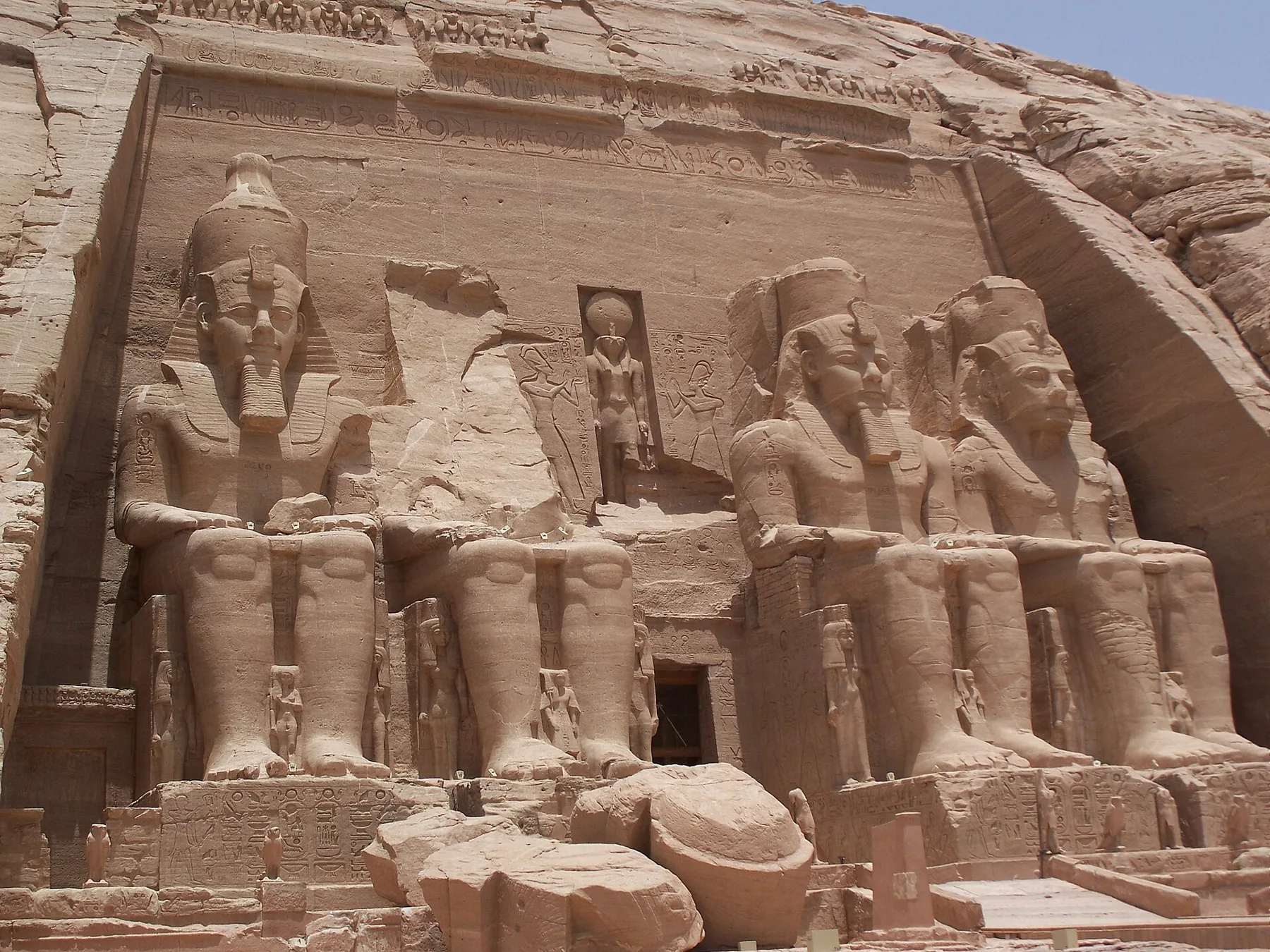
Two temples cut into the rock face above the Nile in Lower Nubia, just north of the Second Cataract, for Ramesses II. The larger, the Great Temple, has four seated colossi of the king on its façade, and its sanctuary holds statues of Ptah, Amun, Ra-Horakhty and the deified Ramesses. The smaller is dedicated to the goddess Hathor and to Ramesses II's Great Royal Wife, Nefertari.
Nubia was not Egypt's frontier at the time. After defeating Kerma early in the Eighteenth Dynasty, Egypt had absorbed Kush as far as Gebel Barkal and the Fourth Cataract and ruled it as a province. On the pedestals of the Great Temple's colossi, the king's name stands above rows of foreign captives, which Toby Wilkinson reads as a statement of his mastery of all peoples.
History
Ramesses II reigned from 1279 to 1213 BC and filled Egypt with temples and statues, many of them usurped from earlier rulers. In Lower Nubia alone he built a series of eight rock temples, two of them at Abu Simbel. Toby Wilkinson calls it his most remarkable project, and its dominant theme the king's own apotheosis.
The four seated colossi on the Great Temple's façade each measure nearly seventy feet, about 21 m. One of them collapsed in an ancient earthquake, and its fragments can still be seen on the ground.
The Small Temple is easy to pass on the way to the large one. On its façade, on either side of the door, a standing statue of Nefertari is flanked by two colossi of Ramesses: six figures in all. Her colossi are the same size as her husband's, a display the official monuments listing calls very rare.
Visitors began writing on the temple in antiquity. Greek, Carian and Judaean mercenaries marching south with Psamtek II carved their names on the legs of Ramesses II's colossi.
Sand blown down from the rock above later buried much of the Great Temple's front. When Giovanni Belzoni first reached it, sand choked the entrance and covered two-thirds of the façade, and one colossus showed only its head and shoulders. Between 1816 and 1819 he directed hundreds of workers to open the entrance, and he records entering on the morning of 1 August, after two voyages.
In the 1960s the lake forming behind the Aswan High Dam threatened the monuments south of Aswan, and UNESCO ran an international campaign to save them from 1960 to 1980. Between 1964 and 1968 both temples of Abu Simbel were dismantled and reassembled on higher ground. The expanding lake also wiped away much of the archaeological record in the area. The site was inscribed on the World Heritage List in 1979.
What you actually see
Inside the Great Temple, a pillared hall leads back into the rock. Each pillar carries a colossal standing figure of Ramesses in the guise of Osiris. At the rear is the sanctuary, where four statues sit carved from the living rock: Ptah, Amun, Ra-Horakhty and the deified Ramesses. Among the reliefs are depictions of the Battle of Kadesh, an encounter from which, in Toby Wilkinson's account, Ramesses snatched survival rather than victory.
On two days a year the sun's rays enter the temple, cross the main hall and light the innermost statues. The official listing gives the days as 22 February and 22 October. Wilkinson writes that Ptah sits permanently in shadow, and gives the days as 21 February and 21 November: the sources disagree on the second date.
Practical
- Open 06:00-17:00 daily, per the Ministry listing read on 2026-09-14.
- The Ministry's tickets cost more on 22 February and 22 October, the two sun days.
- Photography rules inside the temples change; check them at the door.