What it is
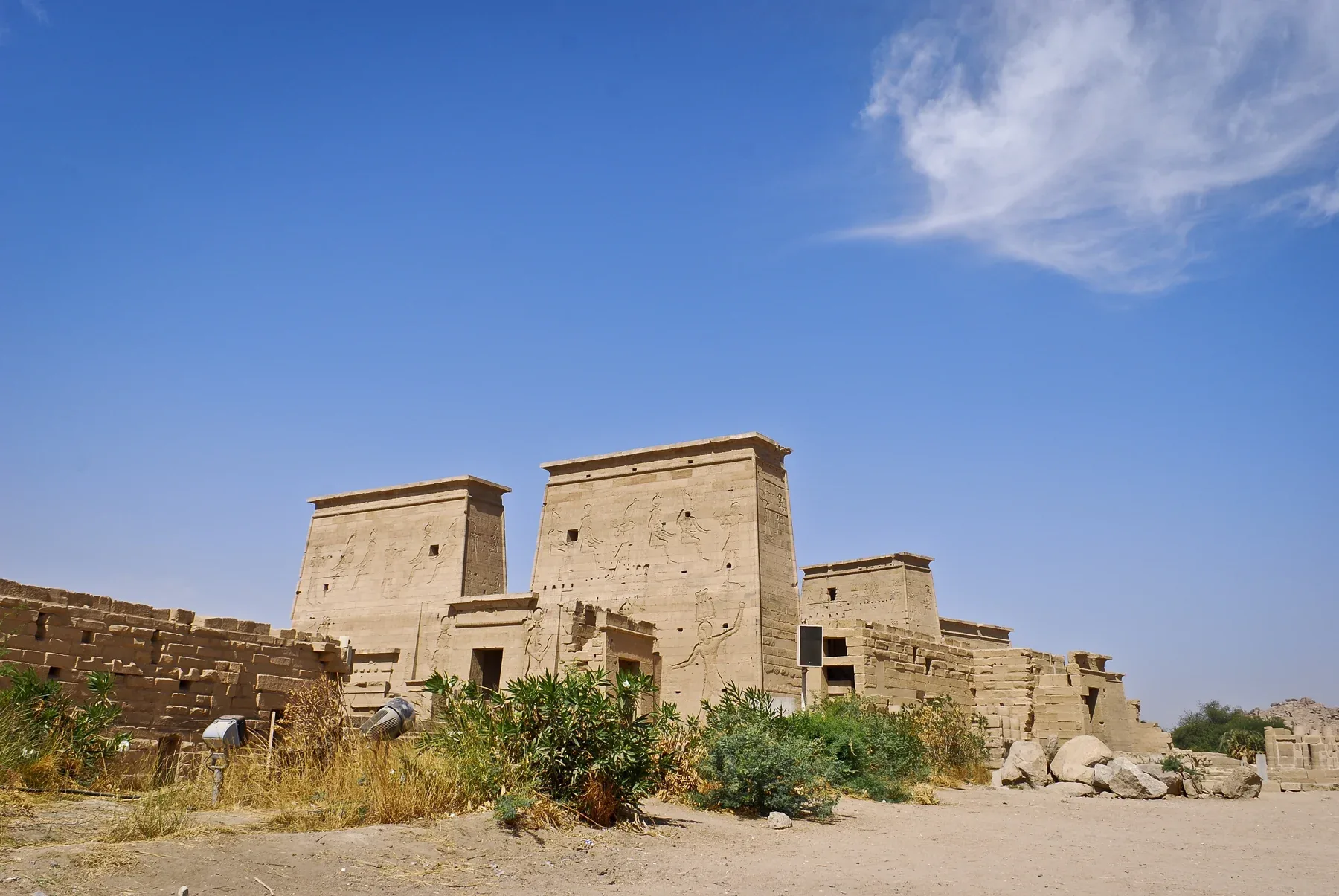
The island that was moved. Philae is a group of temples, gateways and colonnades dedicated above all to Isis, built between the last native Egyptian dynasty and the Roman emperors. The island they were built on now lies under water. What you visit was taken apart in the 1960s and rebuilt on the higher ground of the neighbouring island of Agilkia, between Aswan and the High Dam, which was landscaped to look like the original.
The Egyptians read the island's name as "island of the time of Re", the moment of creation. Its history is in fact late. Philae mattered most in the final centuries of Egyptian religion, as the leading cult centre of an Isis revered throughout much of the Roman world, and it was one of the last Egyptian temples still in use.
History
The sources disagree about where the story starts. R. H. Wilkinson's Complete Temples traces the earliest religious building on the island to Taharqa of the Twenty-fifth Dynasty. The Oxford History places the earliest cult buildings in the Twenty-sixth. Wilkinson's Gods and Goddesses says the temple of Isis itself was begun by Nectanebo I (380–362 BCE) of the Thirtieth Dynasty.
The oldest structure still standing is Nectanebo I's kiosk, and his work greatly enhanced the cult site. On the oldest standing section of the Isis temple, his throne name is identical to that of Senwosret I, one of the great kings of the Twelfth Dynasty. The Oxford History reads this as intentional, part of an effort to promote Philae as a major centre of Isis.
The main temple of Isis was begun under Ptolemy II Philadelphus (285–246 BCE), according to the official listing and Toby Wilkinson, and Philae became a major focus of Ptolemaic temple building. Alan Lloyd notes that here, as at Edfu, the Ptolemies affirmed their links with the last native dynasty. Later rulers added the birth house, begun under Ptolemy VI, and the first pylon of Ptolemy XII. The temple of Hathor is credited by R. H. Wilkinson to Ptolemies VI and VII, and by the official listing to Ptolemy VI and Augustus.
Philae stood at the first cataract, where Egypt met Nubia, and Nubian gods were honoured beside Egyptian ones. A small kiosk for the Nubian god Arensnuphis, called there the companion of Isis, was built and decorated jointly by Ptolemy IV and the Meroitic king Arqamani. A chapel was also given to Mandulis, a solar god of Lower Nubia.
Rome kept building. Augustus had a temple on the island and was identified here with Zeus Eleutherios. Trajan's kiosk shows the emperor making offerings to Isis, Osiris and Horus; as David Peacock observes, the emperor appears there not as a god but as a supplicant to the old gods. Hadrian added a gateway, and Diocletian's gateway and quay stand at the north of the island. Roman visitors carved their names on the temple of Isis in 116 BCE, leaving the oldest surviving Latin inscriptions in Egypt.
Across the water lay the island of Biga. By the start of the Graeco-Roman period it was held to be both the tomb of Osiris and the source of the Nile. It was closed to people, and so became known in Greek as the Abaton, "the forbidden place". Biga was originally the more important island, but because it was forbidden, the temples grew on Philae instead.
Philae outlasted almost everything. Worship of Isis continued here into the sixth century AD, long after most of the Roman world had become Christian. In 394 AD a priest of Isis named Esmet-Akhom carved the last dated hieroglyphic inscription known, and demotic graffiti continued to AD 452. The Byzantine emperor Justinian I ordered the pagan temples closed; the temple was converted into a church, and many of its inscriptions were deliberately destroyed.
When the Aswan High Dam was built, the monuments were dismantled and reconstructed on Agilkia during UNESCO's campaign to save the monuments of Nubia, the same campaign that moved Abu Simbel. Philae is exceptionally well preserved because relatively little of its stone was ever taken away for use elsewhere.
What you actually see
In R. H. Wilkinson's account, boats land at the ancient quay at the south-western corner of the island, beside the kiosk of Nectanebo I. From there a processional way runs north between two colonnades. The western one is the more complete; its windows looked out towards Biga, and a nilometer descends the cliff beneath it. The eastern colonnade was never finished. Behind it lie the destroyed temple of Arensnuphis, the ruined chapel of Mandulis and, better preserved, a chapel of Imhotep, the deified chief architect of King Djoser.
The temple of Isis is entered through the first pylon of Ptolemy XII, carved with the conventional scene of the king striking down his enemies. A gate in its western tower leads into the birth house, where Isis nurses the infant Horus in the marshes on the outside of the back wall. Along the east side of the forecourt, a colonnade fronts rooms that include a "library" dedicated to Thoth. The second pylon is built on a natural outcrop of rock and stands at an angle to the first. Inside, the sanctuary still holds the pedestal for the sacred boat of Isis, dedicated by Ptolemy III and Berenike; the granite shrines that once stood there were taken to European museums in the nineteenth century.
West of the temple, Hadrian's gateway carries a scene of Isis watching a crocodile carry the body of Osiris to the mound of Biga, which rose opposite this gateway on the original island.
East of the temple are the remains of the temple of Hathor, with figures of Bes and an ape playing a stringed instrument. South of it stands the building most people come for: Trajan's kiosk, nicknamed "pharaoh's bed". Fourteen columns joined by screen walls still carry its architraves; the roof, probably of timber, is long gone. It once served as the formal entrance to the island, and two of its screen walls show Trajan making his offerings.
Practical
- Open 07:00-16:00 daily, per the Ministry listing read on 2026-09-14.
- The island is reached by boat.
