What it is
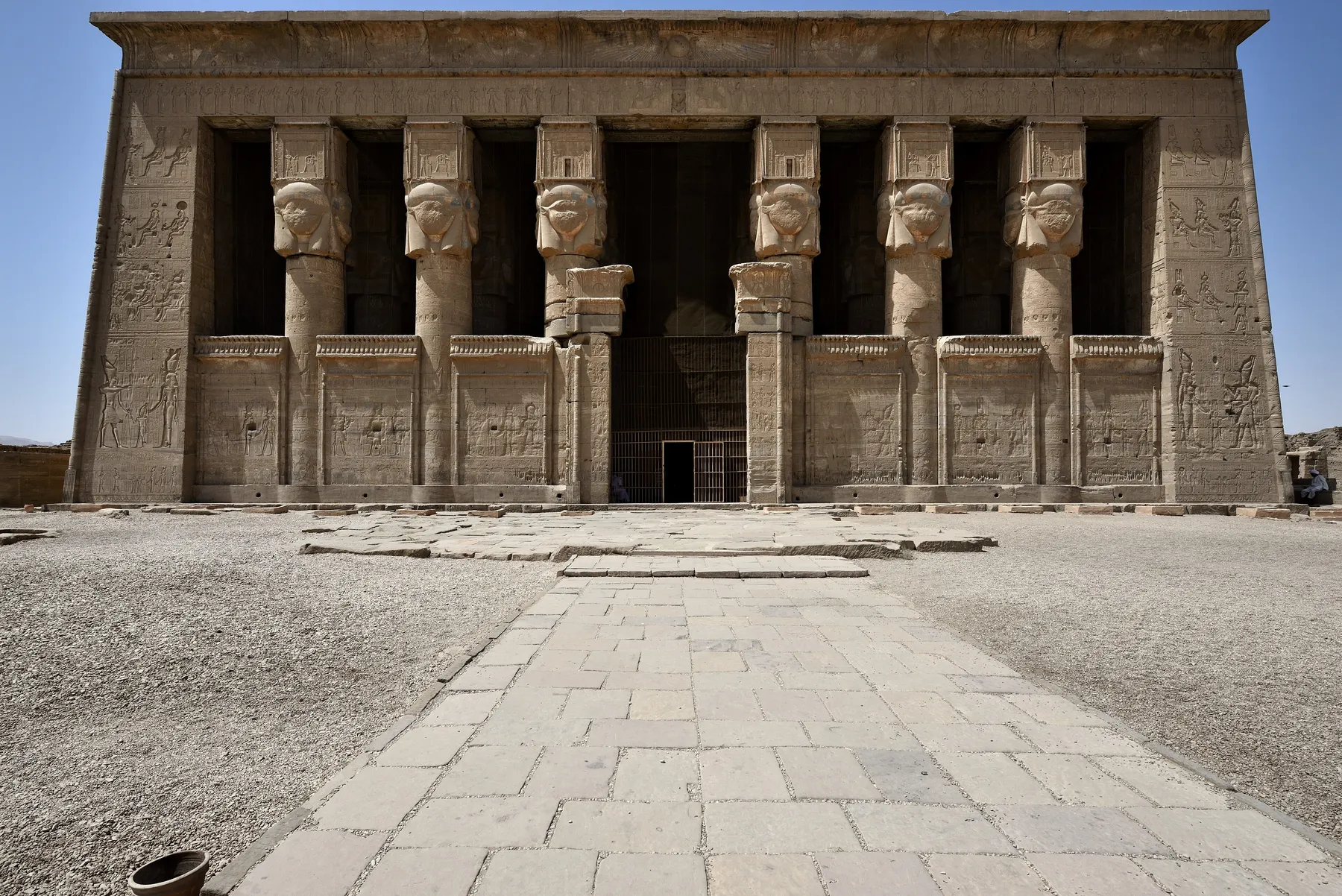
The temple of the goddess Hathor at Dendera, on the west bank at the great bend of the Nile near Qena, about 70 km north of Luxor. Hathor was a goddess of love, music and dancing, and the Ministry's listing calls her "the lady of the sky". Here she was worshipped with Horus of Edfu and their child Ihy. Both our main sources count the temple among the best preserved of its period in Egypt.
The question to carry inside: how did a temple make a goddess, and the sky itself, present to the people who came to it?
History
The site is far older than the building. A temple stood here from the Old Kingdom, and the Ministry names Pepy I among its early builders. New Kingdom kings, among them Tuthmosis III, Amenophis III and Ramesses II, embellished it, and the temple you see replaced one built by Nektanebo I.
It belongs to the Ptolemaic and Roman periods. The earliest king named in it is Ptolemy XII, and most of it was built under Cleopatra VII. Many of the royal name rings inside were left blank, probably because it was not always clear who would be ruling by the time the carving was finished. The great columned hall at the front was added under the Roman emperor Tiberius.
Dendera was bound to Edfu. Every year Hathor's image travelled upriver to celebrate her marriage to Horus in a two-week public festival, stopping at Thebes and other sacred places on the way. The two temples were related by craft as well as by myth: men who worked on the pylon at Edfu also worked at Dendera, and their plans are very similar.
What you actually see
The temple faces north rather than east, because it follows the bend in the river. Its front is a low screen, and above it rise the capitals of the great hall's 24 columns, each carved with the face of the cow-eared goddess. Every one of those faces was attacked in antiquity; Wilkinson's caption blames early Christians. Look up inside. The ceiling keeps much of its colour and is a chart of the heavens: signs of the zodiac, and the sky goddess Nut, who swallows the sun each evening and gives birth to it at dawn.
The rest of the temple is built around a journey. The most precious thing kept here was a statue of the ba of Hathor, hidden in crypts built into the walls and under the floors. At New Year it was carried up the west staircase, whose walls show the king and priests climbing with her shrine, to spend the night in a chapel on the roof and meet the rising sun. The procession came back down the east staircase, where the carved figures descend. The small kiosk on the roof where this renewal took place survives uniquely well.
The roof also holds chapels for the death and resurrection of Osiris. One of them had the famous circular zodiac on its ceiling. It was found during Napoleon's expedition and removed to France in the 1820s, though the sources differ on the exact year and on who took it. The original is in the Louvre, and a copy is in its place. Bagnall and Rathbone report that it is now thought to date from 28 December 47 BC, in Cleopatra's reign.
Then look for the people. Pilgrims waited on this roof for signs and miracles, and scratched gaming boards into the stones to pass the hours. Walk round the outside to the back wall. Cleopatra and Caesarion, her son by Julius Caesar, appear there in huge figures. At the centre is a great false door with the emblem of Hathor, worn away by pilgrims who scraped at the stone to take a little of it, at the place where they came closest to the goddess.
In front of the temple stand birth houses where the divine birth was celebrated, among them a Roman one built by Augustus, with the god Bes carved above its columns, and a church of the fifth century between them. Beside them is a mud-brick sanatorium, the only one known from an Egyptian temple, where the sick bathed in sacred water or slept in the hope of a healing dream. The stone-lined sacred lake is the best preserved of its kind.
Practical
The Ministry listing read on 29 September 2026 gives opening hours of 07:00 to 17:00 every day and a ticket for foreign adults of EGP 300 (students EGP 150). The roof (listed as "panorama") and the crypt (listed as "serdab") each need their own EGP 100 ticket. Recheck before visiting.
In our judgement, buy both: they hold what the temple was for, the goddess hidden in the dark and brought up to meet the sun.
.jpg)