What it is
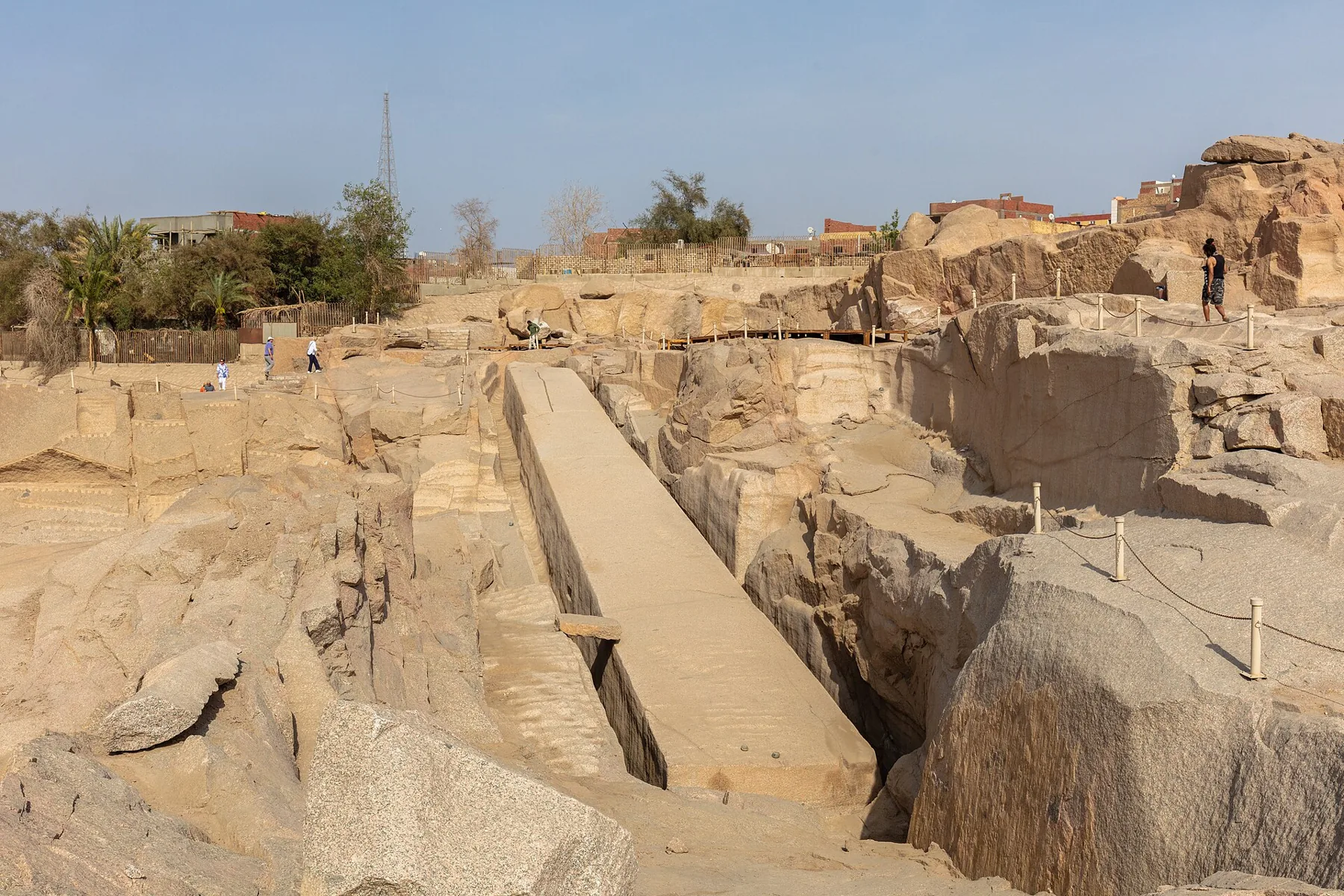
The most famous obelisk in Egypt is the one that never left the ground. It still lies face up in the granite of an Aswan quarry, three sides freed from the bedrock and the fourth still joined to it, abandoned when the stone cracked. The Ministry of Tourism and Antiquities gives its intended size as around 42 metres and 1,168 tonnes, taller than any obelisk Egypt ever raised.
Every finished obelisk you will see at Karnak or Luxor hides how it was made. This one shows it. The question it answers is simple: how do you cut a single stone the height of a fourteen-storey building out of a granite hillside, with no iron tools?
History
The Ministry records the belief that the obelisk was commissioned by Hatshepsut for the temple of Amun at Karnak, and that work stopped because of flaws and fissures in the stone. That attribution is a belief, not an inscription: the obelisk was abandoned before any text was carved on it.
Aswan was the source because of the granite, and because of the river. Elizabeth Bloxam, who has worked on Egypt's ancient quarries, notes that at Aswan, where the quarries lie directly on the Nile, objects seem to have been almost completed in the quarry before they were moved. Recent research there suggests that canals were cut into the Unfinished Obelisk quarry, so that the great stones could go out by water with no overland haul at all.
The work itself was done by pounding. Barry Kemp describes, from Reginald Engelbach's study of the obelisk quarry, a trench cut to separate a block from the parent rock by concentrated pounding with globular balls of dolerite, a stone harder than granite. On the smoothed face beside it, overseers painted columns of red triangles, one column for each man's working position, with what seem to have been the workers' names written beside them. Many of the marks are about 7 cm apart. Kemp asks whether that was one day's progress, and suggests the stretch he illustrates represents around fifteen men cutting the trench in under twenty days, perhaps with their rations depending on it.
Bloxam adds a caution that matters for anyone picturing the scene: stone tools, together with fire, seem to have been the key technologies in the Aswan granite quarries from the Old Kingdom until at least the Ptolemaic Period, and their role is often undervalued.
What you actually see
Look first at the size of the shaft and then at its edges. The trenches on either side are not cut straight. They are made of rounded, overlapping hollows, each about the width of a pounding ball: the marks of the method Kemp describes. Then look for the cracks that crossed the stone. They are the reason you can walk beside an obelisk here and not only look up at one.
Aswan's granite quarries were worked for centuries, and the obelisk lies among the traces of other extractions. We would give the site time to be read as a workplace, not only as a single broken monument.
Practical
The Ministry listing read on 19 September 2026 gives opening hours of 07:00 to 16:00. Recheck before visiting. The quarry is open ground with little shade: in our judgement it is best seen early.
