What it is
A granite island at the first cataract, where Egypt used to end. The Ministry of Tourism and Antiquities calls it the gateway into Egypt for traders coming from Nubia. For three thousand years people built here on top of what came before, and because the island is made of boulders, they often could not clear the old buildings away. They buried them instead.
That is what makes Elephantine rare. It keeps the beginning of the story. The question it answers is one almost no other site can: what did an Egyptian sanctuary look like before it became a temple?
History
The answer lies under the temple of the goddess Satet. In the 1980s and 1990s the German Archaeological Institute found there an Early Dynastic shrine, together with a fortress of the First Dynasty and a town wall of the Second. Barry Kemp describes the shrine's origin as a corner at the back of a natural niche between the boulders, which must have looked like a small cave. Some unknown person, in the Predynastic Period, must have begun to treat it as a place to reach the spirit world; the rock itself was left untouched, and small brick rooms slowly enclosed the space in front.
That modest arrangement, a niche served by brick shelters, lasted for roughly six centuries, until the Eleventh Dynasty. Hundreds of small offerings were left on its floors, mostly in blue-green faience: figures of children with their fingers to their mouths, baboons, frogs, crocodiles and a hedgehog, and forty-one curious plaques ending in a hedgehog's head. None of them shows a god in the formal style of later temples. Only at the end of the Old Kingdom does a granite shrine of Pepi I tell us that the place belonged to Satet, who later appears with Khnum and Anukis as the island's three gods. Two kings of the Sixth Dynasty, Merenra and Pepi II, scratched their names on the granite of the niche, Merenra to commemorate a campaign into Nubia.
Later builders monumentalised the site. Intef II was the first king to build chapels for both Satet and Khnum and to name himself on their doorframes. Under Thutmose III the old shrine was pulled down, its niche and court filled with stone to the top of the boulders, and a larger temple built on the new platform. Yet the builders did not let go of the old ground. They placed the new sanctuary over the old one and joined them with a stone-lined shaft running down through the foundations to the floor of the early sanctuary.
The island had one more community whose story survives in writing. Under Persian rule in the fifth century BC, a Jewish garrison lived on Elephantine, and its Aramaic papyri give, in the words of the Oxford Handbook, unprecedented insight into a foreign community within Egypt. In 410 BC, after a conflict with the priests of the ram god Khnum, their temple of Yahweh was destroyed.
What you actually see
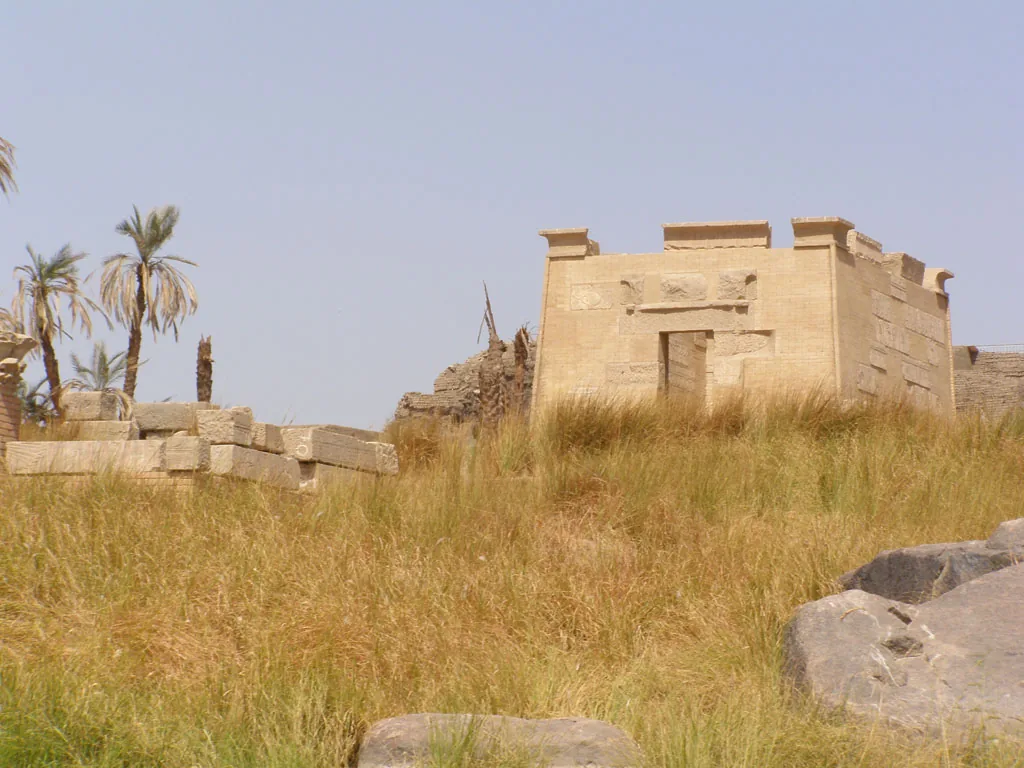
The island is a field of ruins among granite boulders, with the remains of ancient houses, the temples of Khnum and Satet, the Nilometer and a museum of finds from the German mission. Our suggestion is to start at the Satet temple, knowing that the oldest sanctuary on the island lies sealed beneath it. Then look out at the rocks of the cataract. They explain both why the frontier was here and why nobody could level the island.
Practical
The Ministry listing read on 19 September 2026 gives opening hours of 08:00 to 16:00. Recheck before visiting.
