What it is
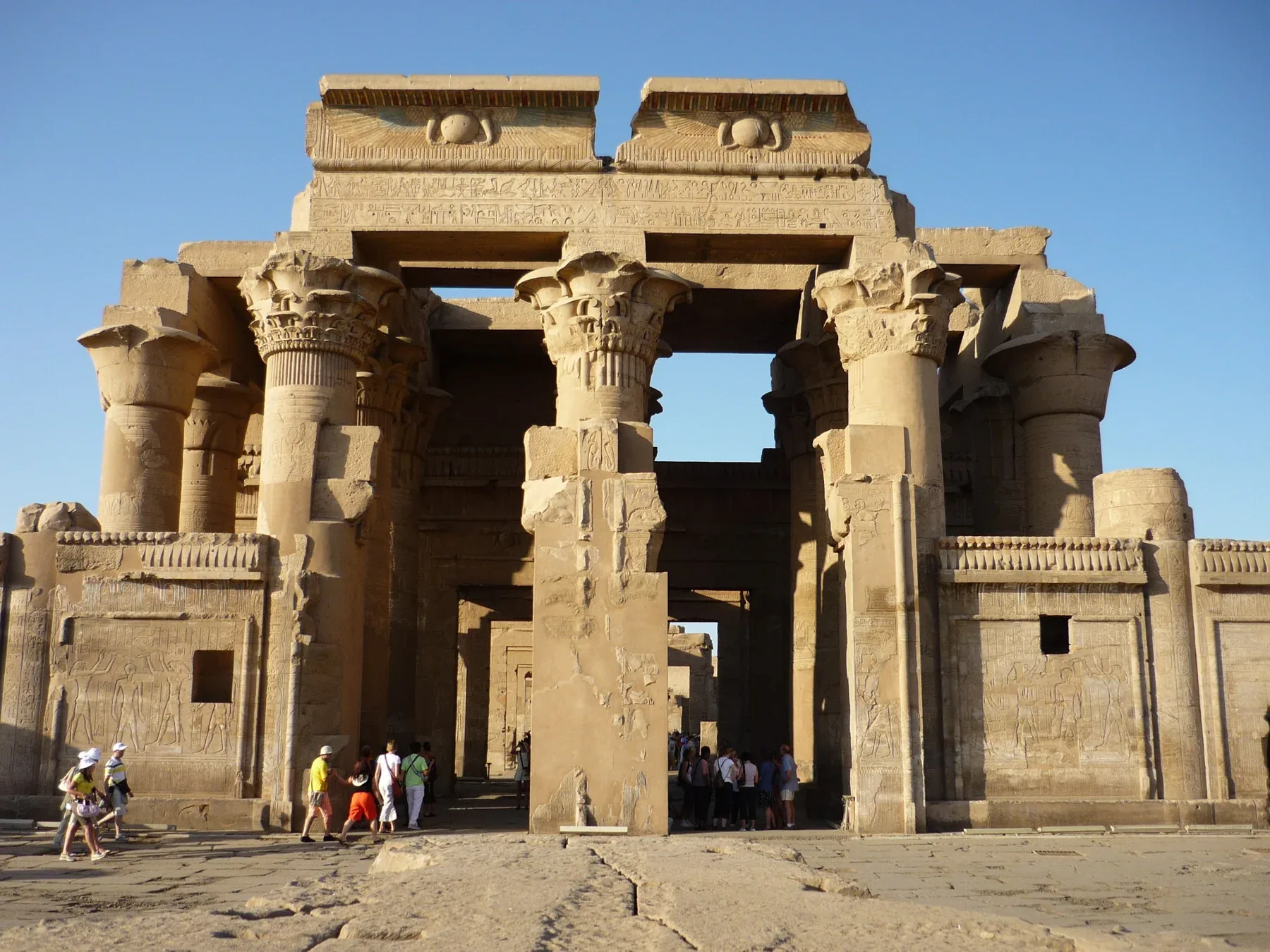
A temple built twice over, side by side, for two gods who could hardly be less alike: Sobek, the crocodile, and Haroeris, Horus the Elder, the falcon. Every part of it is doubled, from the gates to the halls to the sanctuaries. Richard Wilkinson gives it the most spectacular setting of any of Egypt's river temples, on a plateau above the river, isolated by two long dry stream beds.
It is also the temple where you can best imagine the people who came to it. The question to carry inside is what it was like to come here with a question, or an illness, and wait for a god to answer.
History
The town was Pa-Sebek, "the domain of Sobek", in a region that belonged to the old falcon god Horus. A temple seems to have stood here in the New Kingdom, perhaps on an older site, but the place only rose to prominence under the Ptolemies, and almost everything you see dates from then. The Ministry of Tourism and Antiquities notes that the name Ombo goes back to the Egyptian Nubt, "the golden (city)".
Ptolemy VI is the earliest ruler named in the temple; most of the decoration was completed under Ptolemy XII, and the outermost parts were added in Roman times. Wilkinson records that the temple was built of local sandstone by troops stationed here, and that Kom Ombo was a training ground for the African elephants used by the army. A Greek text in the temple records the troops' contribution to the cult on behalf of Ptolemy VI and Cleopatra II. Like Edfu and Philae, it is a reminder that many of the temples visitors take for pharaonic masterpieces are substantially Ptolemaic and Roman.
Each god brought a family. Sobek was worshipped with Hathor and their son Khonsu, the moon god. Haroeris was worshipped with Tasenetnofret, "the perfect companion", and their son Panebtawy, "lord of the Two Lands", who personified the king as rightful heir. Sobek himself was a god of water, said in one tradition to have made the Nile from his sweat, and could stand for the strength of the king.
What you actually see
The doubling is the building's argument. The court was divided between the two gods, Sobek on the east and Haroeris on the west, with an altar in the middle and a libation basin for each. The two hypostyle halls repeat the division, and two separate paths lead through to twin sanctuaries.
Then look for the people. The sanctuaries are broken down enough to reveal the secret chamber beneath them, which priests used to overhear petitions or deliver oracles on behalf of the gods, and much of the inner temple is honeycombed with crypts and passages. In the outer corridor, towards the left end of the back wall, is the famous and controversial scene of the king presenting a set of instruments, some certainly ritual, some perhaps surgical. Pilgrims came to Haroeris the Healer to be treated, and while they waited in the hallways they scratched game boards into the floor. At the centre of the back wall, the false door is flanked by carved ears and eyes: the god listening and watching.
On the east side of the precinct is a small chapel of Hathor, where mummified crocodiles are kept with their clay coffins. On the west is a deep well, and a pond where the sacred crocodiles are believed to have been raised.
Practical
The Ministry listing read on 19 September 2026 gives opening hours of 07:00 to 21:00. Recheck before visiting. In our judgement the late closing is a reason to come at the end of the day rather than in the midday heat.
