What it is
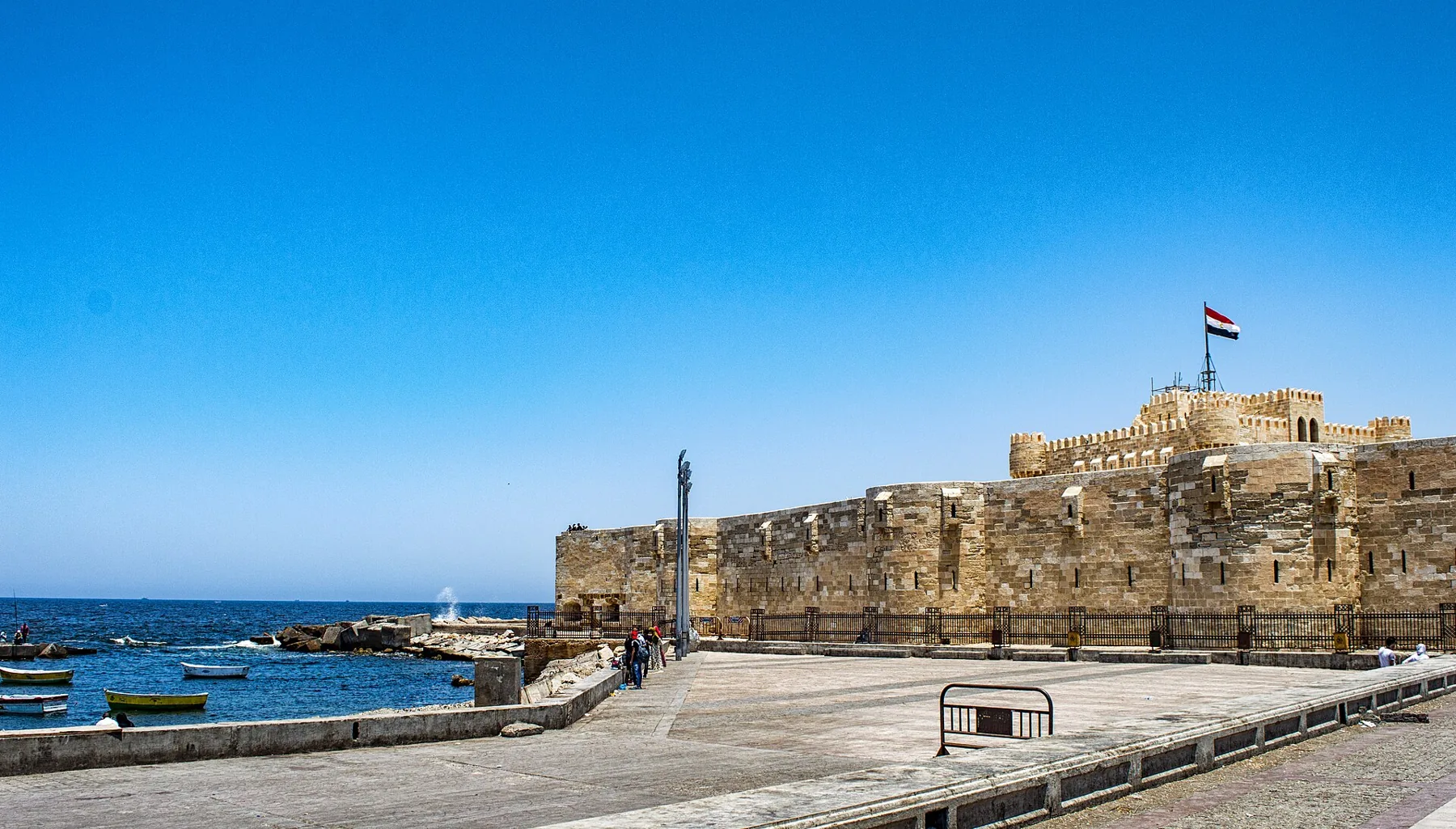
A Mamluk fortress at the tip of Alexandria's eastern harbour, built on the ruins of one of the Seven Wonders of the ancient world. The Ministry of Tourism and Antiquities records that Sultan al-Ashraf Qaitbay built it between 1477 and 1479 over the remains of the Lighthouse of Alexandria, to defend the city against attack from the sea.
The Lighthouse, the Pharos, is gone. The question the fort answers is where it went.
History
The Pharos was commissioned by Ptolemy I and completed by his successor in 280 BC, on a rocky islet joined to the mainland by a long breakwater, and it towered hundreds of feet into the sky. Alan Lloyd calls it the most spectacular of all Alexandria's buildings. Toby Wilkinson adds a sharp note: the Pharos may have been a beacon to a land of opportunity for Greek settlers, but it was no Statue of Liberty, since the Egyptians of the countryside were ruled rather than welcomed.
Some of it is still here, underwater. In 1996 French and Egyptian archaeologists spent more than four months diving in the eastern harbour and found columns, capitals, lintels, fragments of colossal statues and Egyptian sphinxes from a part of the city that had disappeared beneath the sea. Toby Wilkinson notes that blocks from the Pharos itself were among the finds near the fort.
What you actually see
A limestone fortress of about 17,550 m², an outer wall with defensive towers, an inner wall enclosing the courtyard, barracks and stores, and a massive three-storey square keep with half-round towers at its corners and a water tank for soldiers and horses. The fort was enlarged and conserved in 2003. Our suggestion is to look out from the walls towards the harbour mouth: the Pharos stood where you are, and part of it lies in the water below.
Practical
The Ministry listing captured on 3 September 2026 gave opening hours of 09:00 to 20:00. Recheck before visiting.
