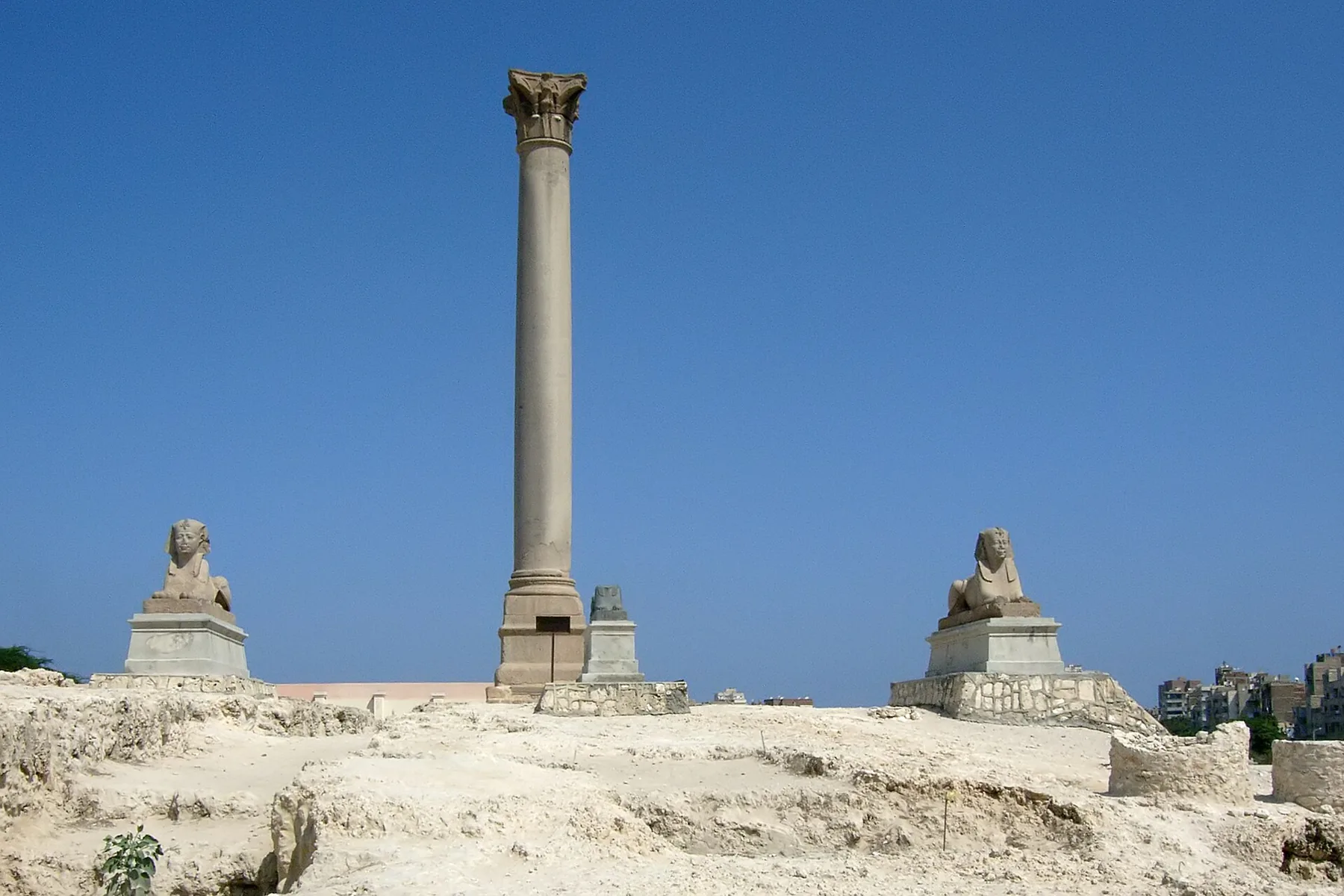
What it is
A single column of red granite standing alone in Alexandria, among the ruins of what was once one of the city's great temples. It has nothing to do with Pompey. Richard Wilkinson records that it was erected by the emperor Diocletian around AD 297, to commemorate the quelling of a riot, and that from the Middle Ages European visitors came to believe it had once carried a globe holding the head of Caesar's rival Pompey. The name stuck.
The question it answers is what stood here before the column, and why so little of it survives.
History
The site was the Serapeum, the chief temple of Serapis, a hybrid god combining Osiris and Apis with the Greek Zeus, shown in the form of a Greek hero. It stood in Rhakotis, the native Egyptian quarter of the city, and was evidently founded under Ptolemy III, though much of it was built in the first centuries AD. Toby Wilkinson notes that pilgrims came from all over the Greek world to Serapis's two great sanctuaries, here and at Saqqara, while native Egyptians remained distinctly unimpressed by a god who looked like a Greek hero. Richard Wilkinson's Gods describes the Alexandrian Serapeum as regarded as a wonder and a place of pilgrimage across the Mediterranean world. A coin from the city's mint of about AD 2 shows the temple, which the emperor Hadrian later rebuilt.
What you actually see
The column itself, on its high base, and very little else. South of it stand two red granite sphinxes, probably Ptolemaic, and a damaged black granite sphinx of the Eighteenth Dynasty. Egyptian statuary adorned the temple, but its architecture was, in Wilkinson's view, more that of a Greek sanctuary. Our suggestion is to walk round the site and read the ground: this is all that is left of a temple that once drew pilgrims from across the Mediterranean.
Practical
Pompey's Pillar is not in the Ministry of Tourism and Antiquities catalogue as captured, and we have not yet confirmed current hours. The Catacombs of Kom el-Shoqafa are about 600 m away. Recheck before visiting.
