What it is
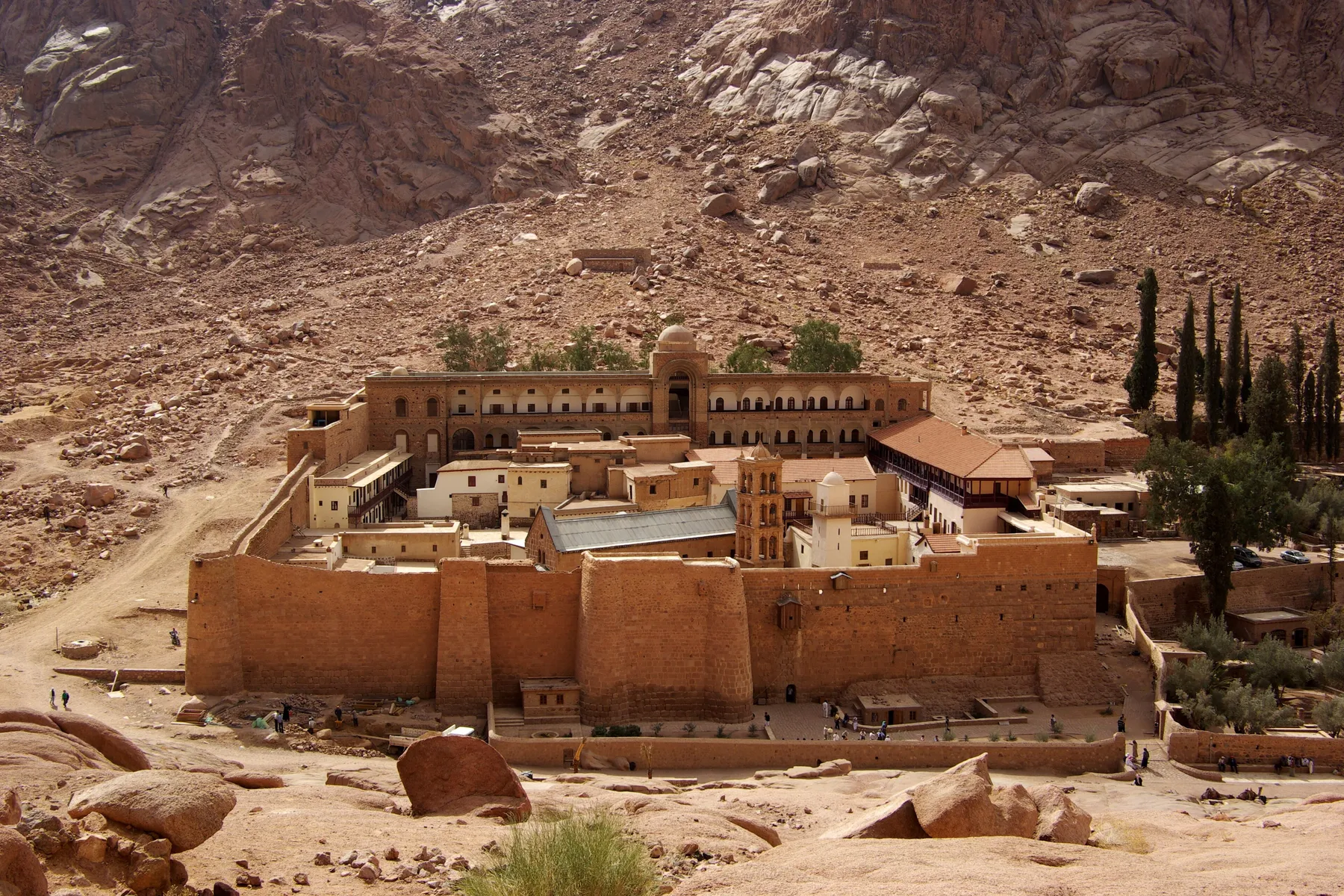
Saint Catherine's Monastery stands just below Mount Sinai, Gebel Musa, in the granite mountains of southern Sinai. Its formal name is the Sacred Monastery of the God-Trodden Mount Sinai. The Byzantine emperor Justinian I had it built between 548 and 565 to house the monks who had lived in Sinai since the fourth century, and it is one of the oldest monasteries in the world still in use.
The question to carry inside: why would an emperor build a fortress for a community of monks?
History
The whole valley is read through the Bible. Tradition places the Israelites' camp on the plain below, the Burning Bush where the monastery stands, and the giving of the Ten Commandments on the mountain above. Monks came to live near these places long before there was a monastery, and Justinian began the fortified monastery after the death of his empress Theodora in 548. The sixth-century wall that still encloses it shows how military its design was: the monks lived in a remote and exposed place.
The monastery is Greek Orthodox, not Coptic, and its buildings follow Syrian and Palestinian models rather than Egyptian ones; its library holds only fragments in Coptic. It takes its name from Catherine of Alexandria, martyred early in the fourth century. By the monastery's tradition, its monks found her body on the nearby mountain that now bears her name in the ninth century, and Bagnall and Rathbone date the placing of her remains in the church to the fourteenth century. A building near the gate, apparently the residence of Roman officials, became a mosque in the Fatimid period; the Ministry dates the mosque to the twelfth century.
What you actually see
The heart of the monastery is its sixth-century church, about 20 by 50 metres. Bagnall and Rathbone call it the Church of the Theotokos; the Ministry calls it the Church of the Transfiguration. It originally had eight side chapels, and the Chapel of the Burning Bush was added in the Middle Ages. Much of its decoration, including mosaics and carved wooden ceiling beams, belongs to the original building, while most of its furnishings and the famous icons are medieval. The Ministry also lists ten other churches, the monks' quarters, a refectory, an olive press, ossuaries, the Fatimid mosque, and a library of rare books with 6,000 manuscripts.
The answer to the question is the wall around you: the emperor was protecting a holy place, and the people who kept it, at the edge of his empire.
Practical
- Open 08:45–12:45; Fridays 10:30–11:30 only; closed on Sundays. The Ministry publishes no ticket price (read 30 September 2026).
- Most visitors come after climbing Mount Sinai overnight for sunrise.
- In our judgement, dress for a working monastery: shoulders and knees covered.
