De quoi s’agit-il ?
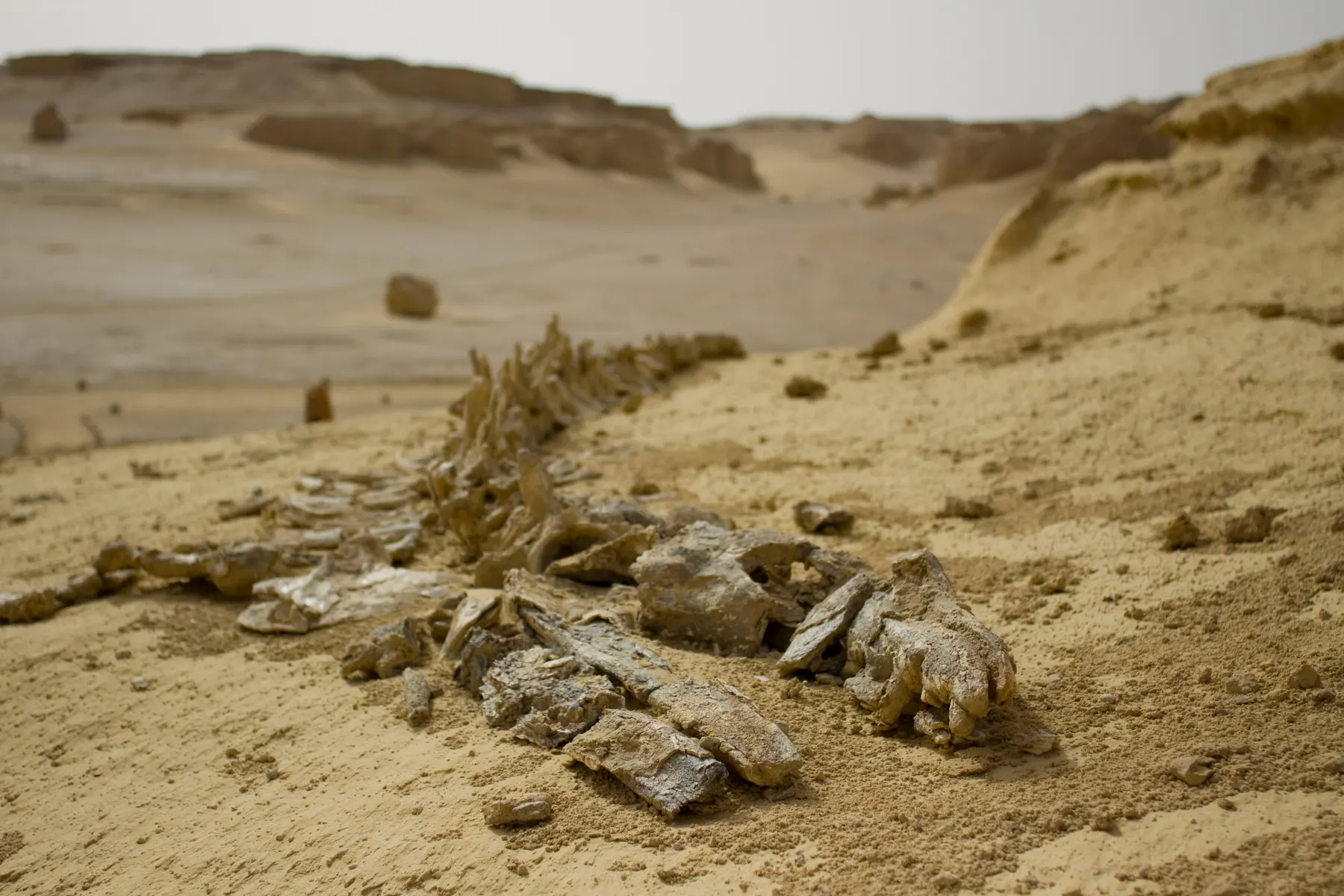
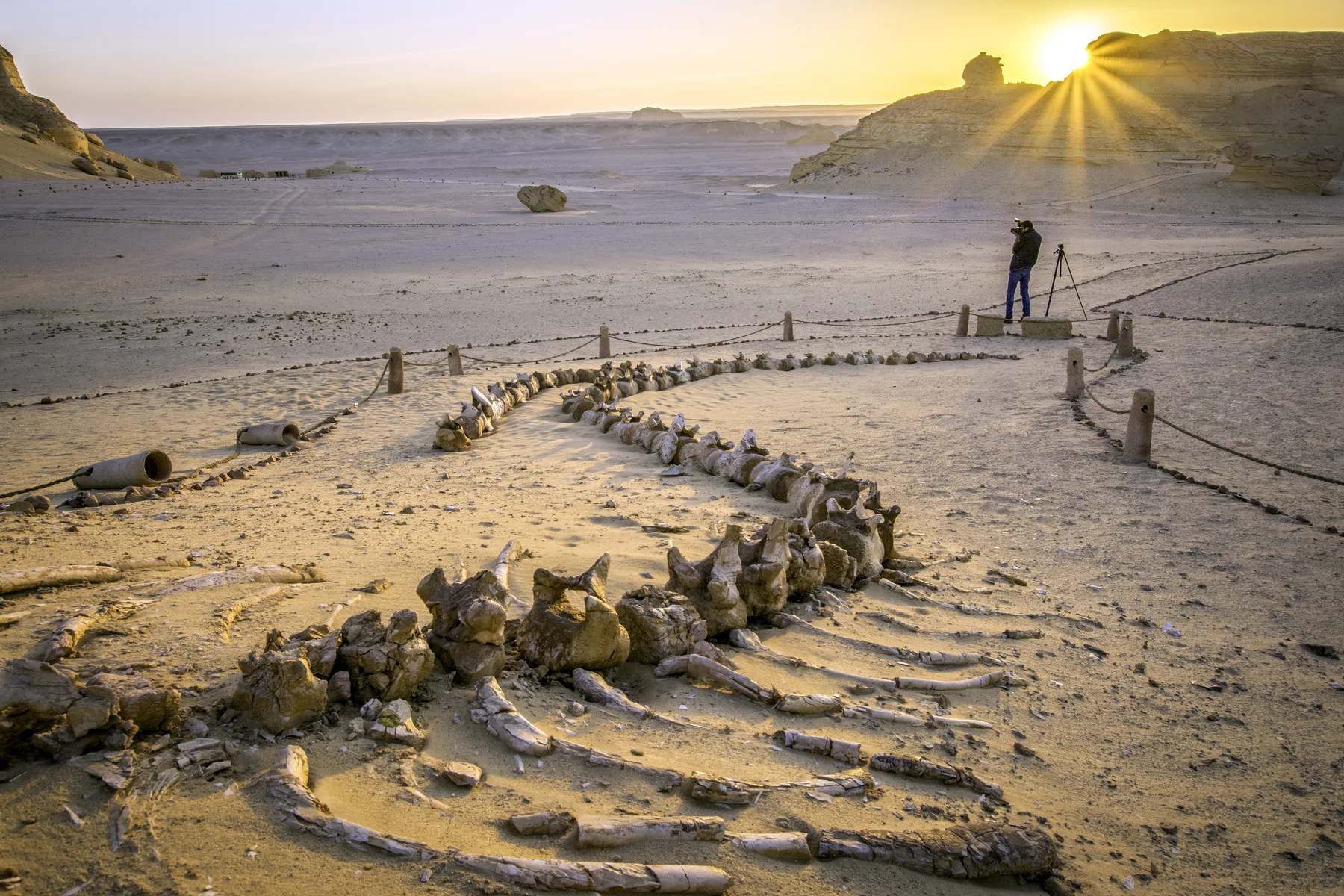
Wadi el-Hitan, the Valley of the Whales, is a desert valley west of the Fayoum where the skeletons of early whales lie in the sand. The Egyptian Tourism Authority describes it as a UNESCO natural World Heritage Site, and IUCN, which advises UNESCO on natural sites, calls it Egypt's only natural World Heritage site. Its fossils record the moment, in IUCN's words, when whales evolved from land-based to ocean-going mammals.
The question to carry: why is there a sea floor in the middle of the Sahara, and why do its whales have feet?
History
Forty million years ago this was the southern shore of an ancient sea, the Tethys. The whale found here, Basilosaurus isis, once called Zeuglodon, averaged about 20 m long, with a slender body and saw-edged teeth. Cassandra Vivian reports that more than 240 skeletons had been found in an area of about 8 km², a former bay where the whales died in great numbers.
The Fayoum's fossils drew scientists from the nineteenth century. The German geologist Georg Schweinfurth found an ancient whale here and named it Zeuglodon osiris. In 1989 Philip Gingerich and Holly Smith of the University of Michigan found that Basilosaurus still had small but complete hind legs, with a femur, kneecap, shin bones and toes, ten million years after whales had entered the sea.
The finds go on. In 2015 IUCN reported the first intact skeleton of a Basilosaurus ever found: about 18 m long, with the tail preserved, and with the remains of its last meals where its stomach had been, among them a crab, a sawfish and a small whale. Shark teeth around it show how the carcass was eaten after death.
What you actually see
Skeletons lie where they were found, laid out along marked paths in the sand, as in the photograph. Vivian describes the valley itself as more beautiful than the White Desert: caramel-coloured boulders and wind-cut outcrops on a plain where small mounds of debris are each an ancient sea creature. Look, photograph, but do not touch: she asks visitors to let the scientific work go on.
Practical
Wadi el-Hitan lies inside a protected area. In 2000 Vivian recorded an entrance fee and ranger patrols, and a 4x4 ascent to the valley; we do not publish a current fee. The tourism authority describes the Fayoum as less than two hours' drive south-west of Cairo. In our judgement the valley rewards an early start and a full day, or a night in the Fayoum, rather than a rushed visit; transport and permits are confirmed with each booking.
Billets, horaires et guides pratiques
- Que faire en Égypte
- Des pyramides aux récifs et au désert.
- La meilleure période pour visiter l’Égypte
- Mois par mois selon les normales climatiques, avec les dates qui changent un voyage.
- Combien de jours en Égypte ?
- Cinq, neuf ou douze nuits, et ce que chaque durée laisse de côté.
- Billets et horaires des sites
- Quinze sites majeurs dans un tableau daté.