Cos’è il museo
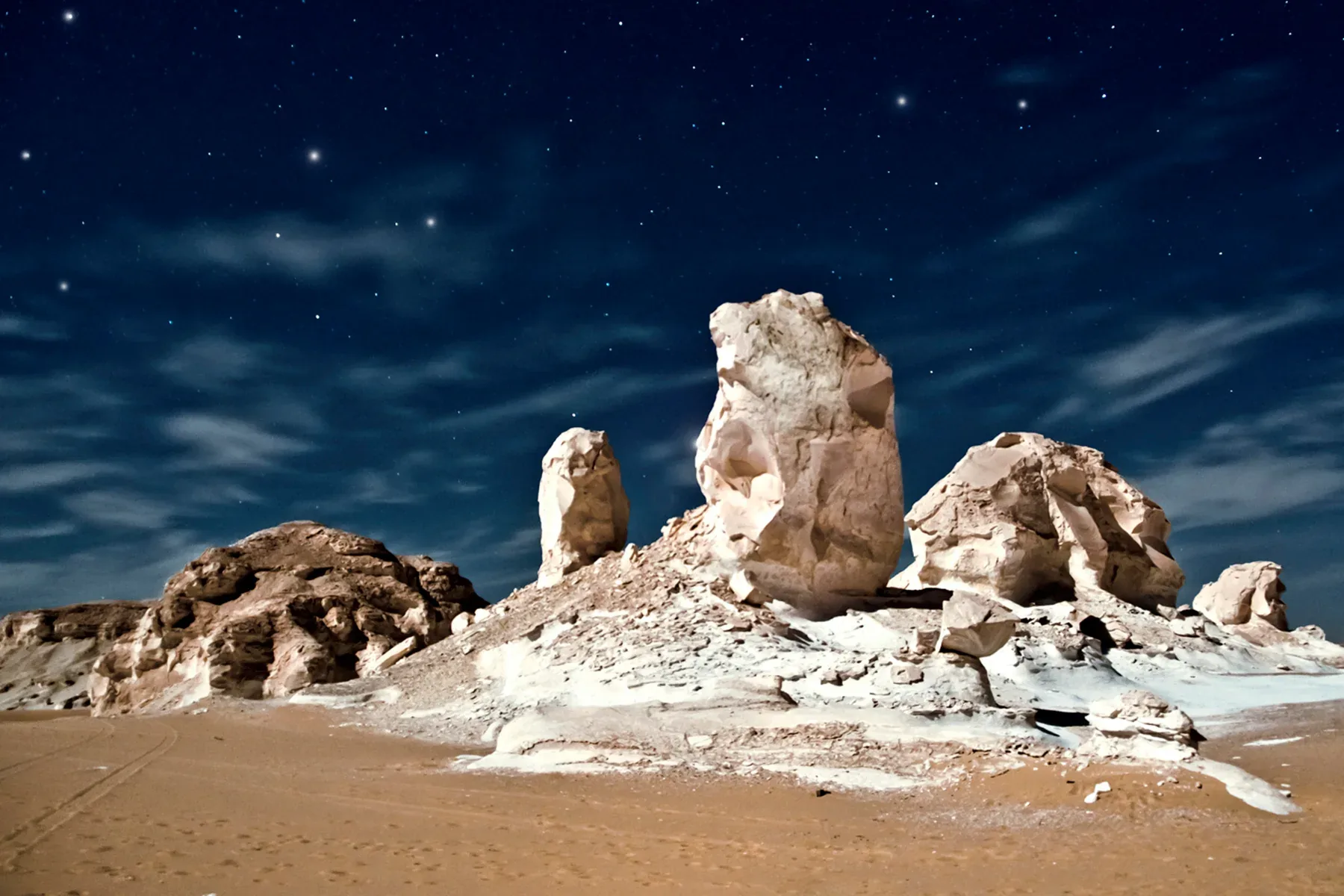
The White Desert is a landscape of pale chalk formations in the Western Desert, north-east of the oasis of Farafra. The Egyptian Tourism Authority names Farafra as a starting point for exploring it. Cassandra Vivian, whose handbook maps the desert track by track, notes that local guides give the name to a small area between Qasr Farafra and the escarpment, but that most of the desert floor from about 8 km north-east of the town carries white outcrops, so the whole area could be called the White Desert.
The question to carry: what made these shapes, and why do they never look the same twice?
History
This is a geological landscape rather than a human-built monument. The tourism authority describes mushroom-shaped white formations, and its Egypt guide attributes them to weathering. Vivian describes the chalk monoliths, or inselbergs, and the wind still at work on them: clipping, chipping and eroding the ridges, and uncovering newer, stranger shapes beneath the surface of the stone. Resemblance to an animal or an object is a visitor's reading, not a geological classification.
The landscape has no monument, but the oasis it belongs to has a long human past. Ian Shaw gives the Bir el-Obeiyid Playa in Farafra, dated c. 9380–8205 BC, as an example of the earliest surviving shelter and subsistence sites in Egypt. John Coleman Darnell lists the handprints of Farafra among the rock art that may have come into Egypt from traditions further afield. In 1209 BC the Libyan chief Mery based his army at Farafra before marching on Egypt, because the oasis commanded a network of desert routes that joined the Nile Valley at different points, and so kept the Egyptians guessing.
What you actually see
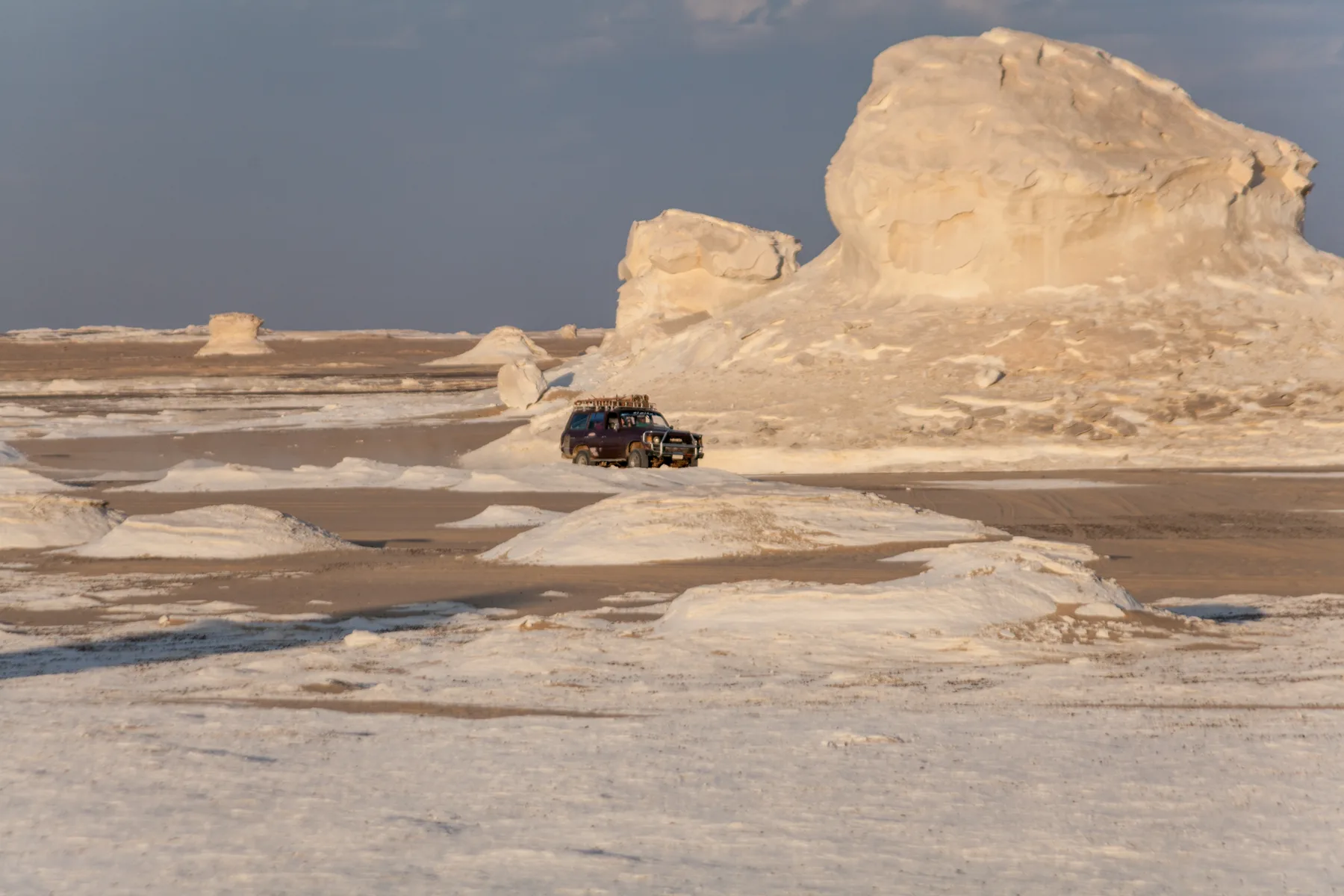
Pale rounded towers and tables of chalk stand on a floor of white and sand, as in the photograph. Vivian writes that there is no perfect time to see them: the colour changes with the hour, glowing at dawn and dusk and almost disappearing into the shimmer of the summer noon. Look at the ground as well. She records small quartz crystals, iron pyrites and fossils on the desert floor, and seashells embedded in the chalk cliffs. Look, and leave them where they lie.
Practical
The Egyptian Tourism Authority advises booking with a specialised, licensed operator, and checking permits and regulations before an excursion. Our White Desert trips run from Cairo by road through Bahariya, with a night in camp; the route, camp and transport are confirmed with each booking. The UK FCDO advises against travel to most of the Western Desert but names the White Desert as an exception; see our Egypt visas and travel advice guide. Vivian notes that some sites beyond the main area need military permission. No direct White Desert-to-Siwa crossing is promised.
Biglietti, orari e guide pratiche
- Oasi di Siwa
- L’oracolo di Alessandro, i laghi salati e il Grande Mare di Sabbia.
- Visti e consigli di viaggio per l’Egitto
- Cosa dicono le fonti ufficiali e come incide sui nostri itinerari.
- Il periodo migliore per visitare l’Egitto
- Mese per mese, secondo le normali climatiche, con le date che cambiano un viaggio.
- Biglietti e orari dei siti
- Quindici siti in un’unica tabella aggiornata.