Was das Museum bietet
The Mosque and Madrasa of Sultan Hasan is one of the largest mosques in Egypt. The Mamluk sultan Hasan ibn al-Nasir Muhammad ibn Qalawun commissioned it between 1356 and 1362, at the foot of the Citadel, opposite the nineteenth-century Mosque of al-Rifa'i. It was a mosque and four colleges in one: around its open courtyard, four vaulted halls, the liwans, were each given to one of the four Sunni schools of law.
The question to carry inside: how did a sultan who was, in Caroline Williams's words, a puppet in the hands of his amirs build anything so imposing?
History
The answer is the plague. Williams explains that the estates of victims of the Black Death of 1348 had swelled the treasury with money for royal endowments. Two amirs' palaces were torn down to clear the site, and architects and craftsmen came from Iran, Iraq and Syria. Work began in 1356 and ended seven years later, but Hasan himself was assassinated in 1361.
The building was meant to dominate the city. Its facade is 76 m long and 36 m high. Two minarets were to crown the entrance, but in February 1360 one of them toppled and killed three hundred people, and the second was abandoned. The work was never quite finished: carved medallions beside the entrance are sketched in but not cut.
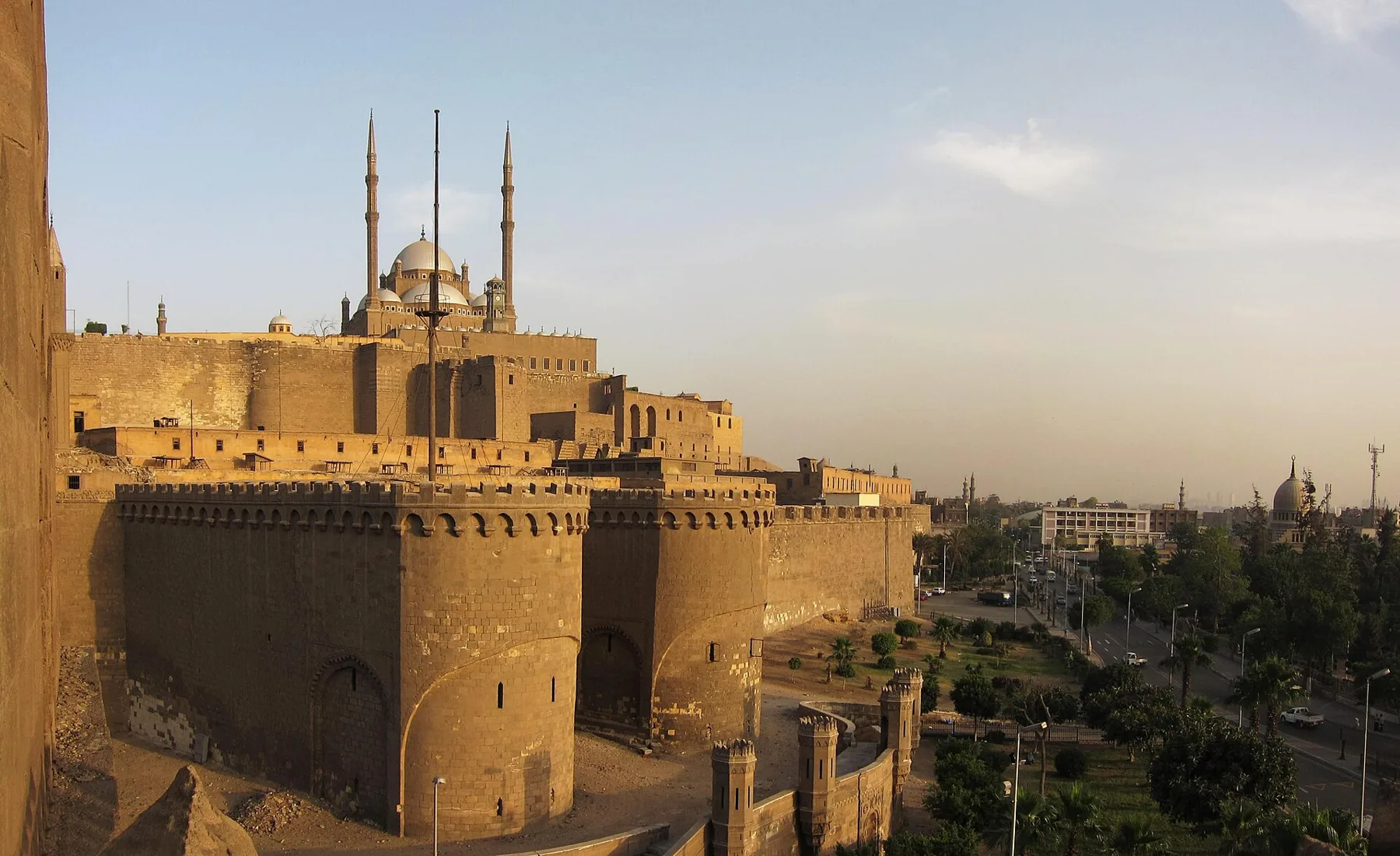
The mausoleum stands behind the prayer wall and faces the square below the Citadel, where the sultans held their parades and feasts. Sultan Hasan is not buried in it: after his assassination his body was never recovered, and the tomb holds two of his young sons. Its closeness to the Citadel made it a fortress more than once. In 1391 rebel amirs climbed its terrace and hurled missiles at the Citadel, and in 1517 it was bombarded while it sheltered Tumanbay, the last Mamluk sultan. A minaret fell in 1659, and it was rebuilt along with the present dome in 1671–72.
What you actually see
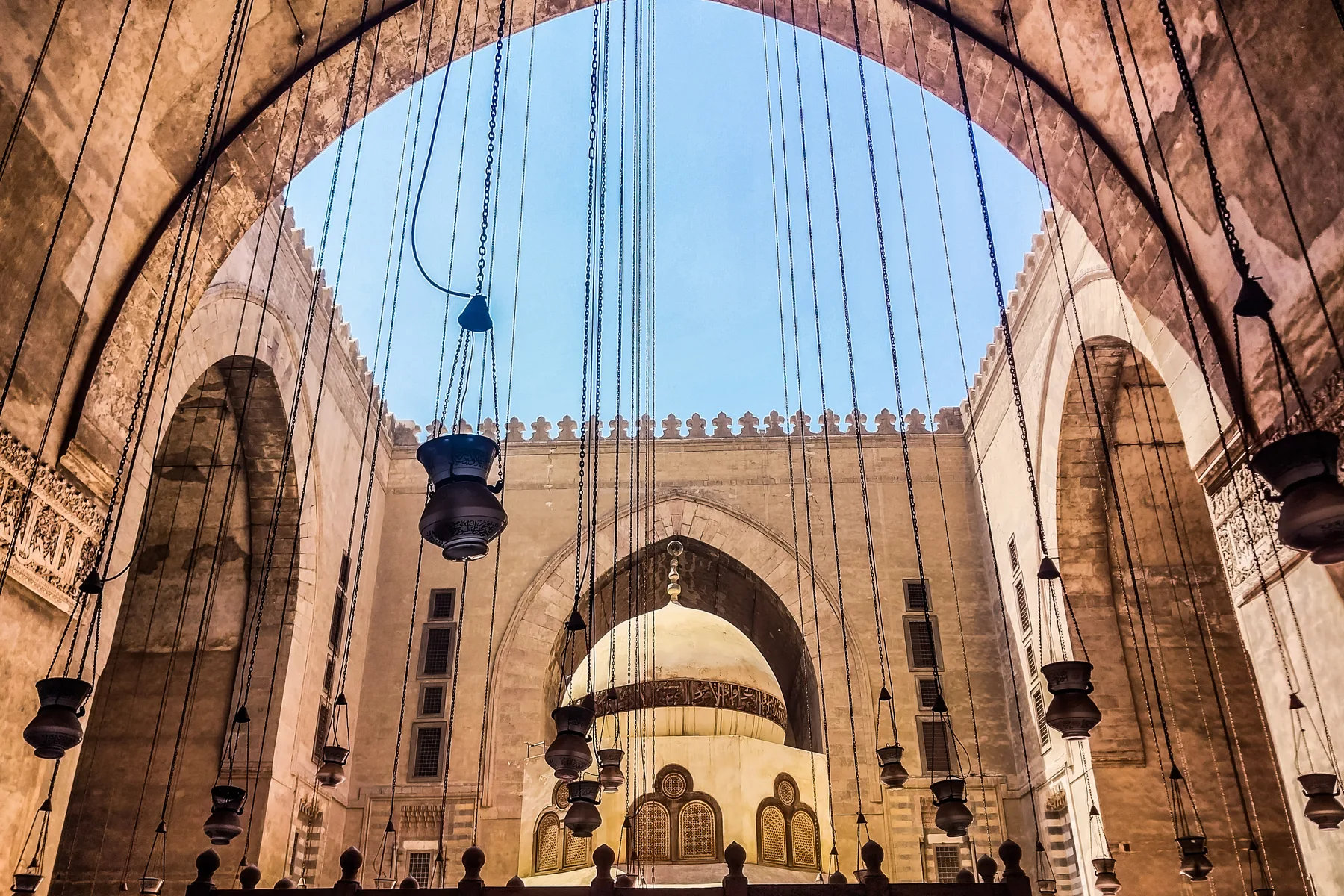
You enter through a portal hung with stone stalactites, then a long, bending passage, and come out into the light of the marble courtyard and its four enormous liwans. The domed fountain in the middle was built for decoration, not for washing, and on great occasions it served sherbet; its present form is Ottoman. The hundreds of chains hanging from the arches once held enamelled glass lamps, as in the photograph. In the eastern liwan, the sanctuary, a band of monumental Kufic script carries the first verses of Sura 48, and beside the prayer niche a bronze door inlaid with silver and gold, the original, leads into the mausoleum.
Practical
The Ministry of Tourism and Antiquities lists Sultan Hasan as open from 09:00 to 17:00. The foreign adult area ticket is EGP 220 and the student ticket EGP 110, and the same ticket admits you to al-Rifa'i Mosque opposite, read on 17 October 2026. Caroline Williams advises coming in the morning, when the sun lights the mausoleum and the western liwan. It is a working mosque, so dress for a place of worship. In our judgement it pairs naturally with the Cairo Citadel above it.
Eintritt und Öffnungszeiten
- Eintritt für ausländische Erwachsene
- EGP 220. Al-Rifa'i-Moschee eingeschlossen. Studierende zahlen die Hälfte.
- Öffnungszeiten
- 09:00–17:00, laut .
- Quelle
- der Seite des Ministeriums für Tourismus und Altertümer zu Sultan Hasan, abgerufen am . Preise können sich ändern; maßgeblich ist die Ministeriumsseite. Alle Stätten in einer Tabelle: Eintrittspreise und Öffnungszeiten ägyptischer Stätten.
Eintritt, Öffnungszeiten und Planungstipps
- Eintrittskarten für die Pyramiden von Gizeh
- Was das Arealticket umfasst und welche Innenräume Sie dazubuchen können.
- Das Grand Egyptian Museum
- Öffnungszeiten, lange Abende, Zeitfenster-Tickets und die empfohlene Besuchsdauer.
- Islamisches Kairo
- Al-Muizz-Straße, Zitadelle und Muhammad-Ali-Moschee.
- Eintrittskarten und Öffnungszeiten der Stätten
- 15 bedeutende Stätten in einer datierten Tabelle.